Best Under-Sink Organizers: Pull-Out Baskets, Stackable Units, and Expandable Frames
The best under-sink organizers for kitchen and bathroom — pull-out sliding baskets, stackable units, and expandable frames. Honest guide, no fake ratings.
In this guide
Affiliate Disclosure:
As an Amazon Associate I earn from qualifying purchases. We do not display live prices, ratings, or availability. This does not affect which products we recommend — our picks are based on research, use cases, and reader needs.
Who This Guide Is For
This guide is for anyone who has opened an under-sink cabinet and found a chaotic collection of cleaning supplies, toiletries, or household items with no clear organization. Under-sink cabinets are some of the most difficult storage spaces to organize because of the plumbing in the way — but the right organizer makes the space genuinely functional rather than just a place to throw things.
We cover four under-sink organizer types: pull-out sliding basket organizers (best for full access to deep cabinets), stackable organizers with movable dividers (best for adjustable customization), expandable frame organizers (best for cabinets where plumbing placement requires width adjustment), and door-mounted racks (best for keeping spray bottles and trash bags off the cabinet floor entirely). We cover both kitchen and bathroom under-sink applications.
How We Chose These Products
We research, compare, and explain products based on use cases, specifications, public product information, and buyer needs. For under-sink organizers, the criteria were: ability to work around plumbing obstacles, practical access to the full depth of the cabinet, recognizable brands with established availability, and distinct product types that solve different under-sink problems. We specifically avoided organizers that require permanent installation or drilling.
Things to Know Before You Buy
Measure before you order — especially depth
Under-sink cabinets vary significantly in size between homes. Standard kitchen under-sink cabinets are roughly 36 inches wide and 24 inches deep, but the actual usable space is often significantly less because of the plumbing. Bathroom cabinets are usually smaller. Always measure the interior width, depth, and height before ordering. Most product listings include dimensions — verify them against your measurements.
Don't forget the plumbing:
The drain pipe and supply lines (and garbage disposal if present) take up significant space. Note where your pipes are positioned relative to the center of the cabinet — this determines whether a single large organizer, two side-by-side units, or an expandable-width organizer will work best.
Pull-out vs. static: the most important decision
Under-sink cabinets are deep enough that anything stored at the back requires you to remove front items to reach. A static organizer without pull-out functionality doesn’t solve this — it just creates a more organized version of the same problem. Pull-out basket organizers are worth the extra cost for any cabinet you use regularly. Static organizers work for low-frequency storage (extra supplies, backup products) where access frequency doesn’t justify the pull-out cost.
Stackable organizers work best in bathroom cabinets
Bathroom under-sink cabinets typically have less plumbing than kitchen cabinets and more usable floor space. Stackable organizer units — which are placed on the floor and stacked vertically — work well in bathroom cabinets where the drain pipe is near the back center and usable side space is available. In kitchen cabinets with garbage disposals, stacking usually requires placing units on each side of the disposal rather than a single centered unit.
Hooks and dividers add functional value
Under-sink organizers with hooks (for hanging spray bottles, gloves, or bags) and movable dividers (for customizing compartment sizes) provide more practical value than fixed-compartment designs. Cleaning supplies vary significantly in size — spray bottles are tall and thin, sponges are short and flat — and an organizer that can be adjusted to match your specific items will be used more consistently than one you have to work around.
A fourth option: door-mounted racks
Door-mounted racks attach to the inside of the cabinet door, using the otherwise-unused vertical surface to hold narrow items upright — spray bottles, dish gloves, trash bag rolls, and similar items. This frees up floor space for larger bins or platforms while keeping frequently used items in view when the door opens. Some designs use tension rods or adhesive mounts, while others require small screws — check the mounting method against your cabinet door material before purchasing. Door-mounted racks are generally designed for lightweight, narrow items; overloading one with heavy bottles can strain the mounting hardware or the cabinet door itself.
Material matters for a space prone to moisture
Under-sink cabinets are more prone to occasional moisture from drips, condensation, or minor spills than other kitchen or bathroom storage areas. Look for organizers made from materials that tolerate incidental moisture, such as coated wire, plastic, or rust-resistant metal, rather than untreated wood or cardboard-based products. An organizer is a storage accessory, not a leak-prevention product — it does not protect against or prevent plumbing leaks. If you have concerns about moisture or leaks under your sink, address the plumbing directly with a qualified professional.
Check vertical clearance before choosing a pull-out design
Pull-out and sliding organizers need vertical clearance to operate — both for the unit itself and for the rails or slides it sits on. If your cabinet has a low shutoff valve or pipe fitting close to the floor, confirm the organizer’s minimum clearance requirement before choosing a sliding design over a simpler fixed shelf.
Quick Picks — Comparison Table
Product | Model & variant | Choosing |
|---|---|---|
mDesign expandable under-sink shelf Objects shown to illustrate use are not a statement of included accessories; see the model and variant details. | 6312MDBST Silver / expandable / two tiers | Measure the cabinet opening and the positions of the drain and shutoff valves. An expandable width does not guarantee that the vertical supports will clear every plumbing layout. |
SPACEKEEPER two-tier under-sink organizer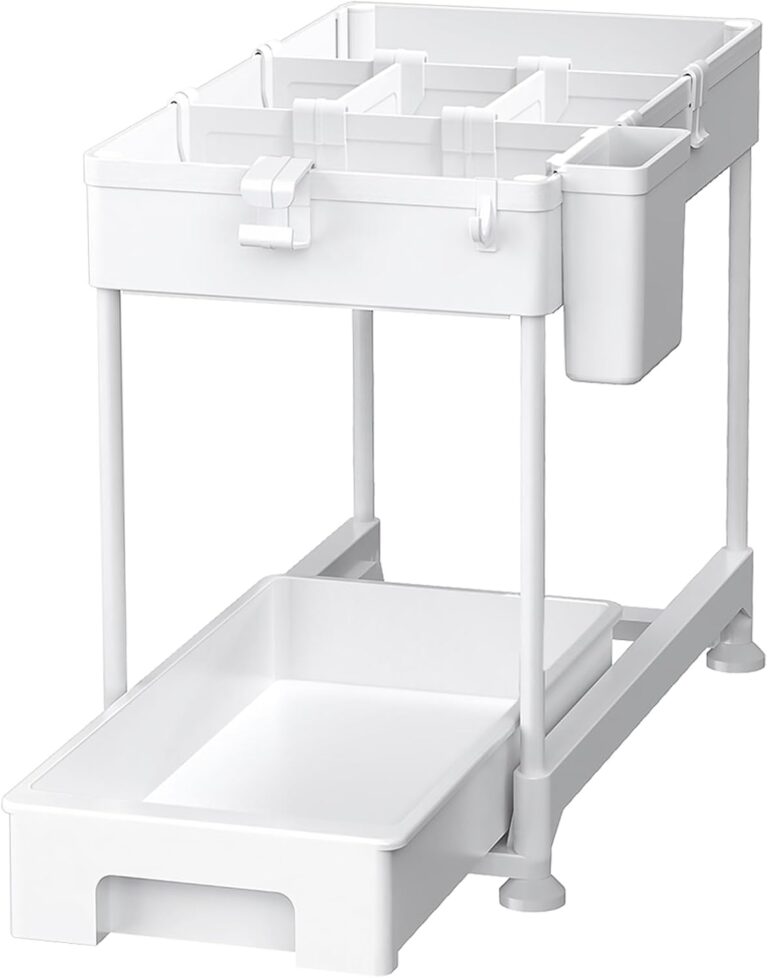 | 2SPKPSC202-EU White / two-tier sliding organizer | Measure plumbing clearance and the door opening with the basket extended. The shelf layout must fit around your pipes; two levels alone do not establish compatibility with a particular cabinet. |
REALINN L-shaped under-sink organizer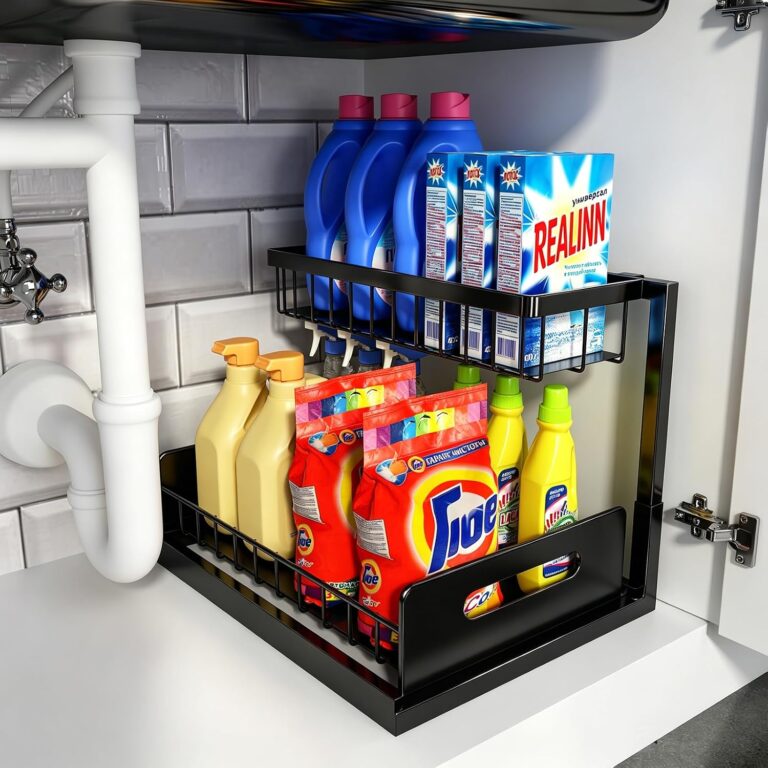 Objects shown to illustrate use are not a statement of included accessories; see the model and variant details. | RL0025 Black / one L-shaped organizer | Measure the location of the drain, cabinet hinges and basket travel. This ASIN identifies one organizer; do not plan the layout around a two-pack shown under another variation. |
Delamu two-pack divided organizers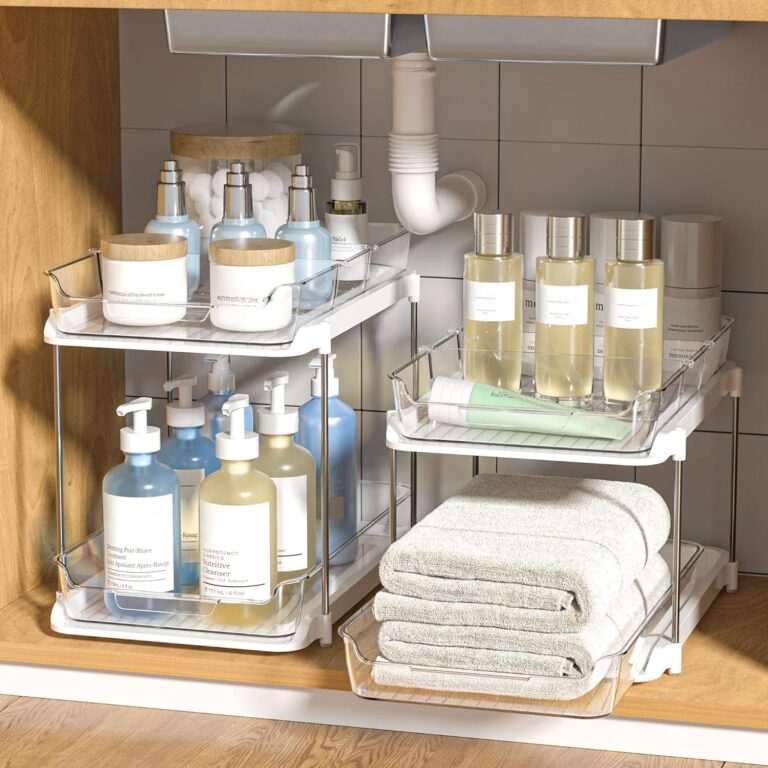 Objects shown to illustrate use are not a statement of included accessories; see the model and variant details. | DLM-SlideOutOrganizer-2Set White/clear / two organizers / movable dividers | Check the size of both units and the clearance needed to pull out each tray. Avoid assuming the divided trays fit tall bottles without checking the space between levels. |
Product Guides
SPACEKEEPER two-tier under-sink organizer
A white under-sink organizer with a sliding lower basket and accessory storage. The two-tier design uses cabinet height while retaining pull-out access to the lower level.
Variant: White / two-tier sliding organizer
Measure plumbing clearance and the door opening with the basket extended. The shelf layout must fit around your pipes; two levels alone do not establish compatibility with a particular cabinet.
View product details →View on AmazonObjects shown to illustrate use are not a statement of included accessories; see the model and variant details.
Delamu two-pack divided organizers
A two-pack of white-and-clear two-tier organizers with pull-out trays and movable dividers. The dividers let you separate smaller bathroom or pantry items inside a tray.
Variant: White/clear / two organizers / movable dividers
Check the size of both units and the clearance needed to pull out each tray. Avoid assuming the divided trays fit tall bottles without checking the space between levels.
View product details →View on AmazonObjects shown to illustrate use are not a statement of included accessories; see the model and variant details.
mDesign expandable under-sink shelf
A silver two-tier under-sink organizer with an expandable shelf. The adjustable span helps compare it with a fixed-width drawer unit when working around plumbing.
Variant: Silver / expandable / two tiers
Measure the cabinet opening and the positions of the drain and shutoff valves. An expandable width does not guarantee that the vertical supports will clear every plumbing layout.
View product details →View on AmazonUnder-Sink Organization Buyer Guide
Kitchen sink vs. bathroom sink: different needs
Kitchen under-sink cabinets typically store cleaning supplies, extra dish soap, trash bags, and in many cases a garbage disposal that takes up central floor space. Bathroom under-sink cabinets are usually smaller but store a more diverse mix of items — toiletries, hair care products, extra toilet paper, cleaning supplies. The organizing approach differs: kitchen cabinets often need one or two large-capacity organizers plus hooks for tall spray bottles; bathroom cabinets often benefit more from smaller compartmented units that separate personal care categories.
What to do about pipes in the middle of the cabinet
Central drain pipes are the most common obstacle in under-sink cabinets. The practical solutions are: expandable-width organizers that adjust around the pipe position, two smaller units placed one on each side of the pipe, or pull-out basket units where the basket can slide clear of the pipe. Whatever you choose, measure the pipe position before ordering — products that advertise “fits around pipes” still have dimensional limits.
Starting simple and expanding later
If you’re unsure where to start, one pull-out organizer that fits the primary use cabinet (usually kitchen or master bathroom) is a better first purchase than two or three different organizers simultaneously. You’ll quickly see what works and what your actual storage needs are before buying more. Under-sink cabinets don’t need to hold everything — move rarely-used items elsewhere so that the under-sink space only contains items you access regularly.
Frequently Asked Questions
Why is under-sink organization so difficult?
The plumbing. Drain pipes, supply lines, garbage disposals, and shut-off valves take up significant floor space in positions that vary between homes. Standard shelf units often cannot be placed flat on the floor without hitting a pipe. The best under-sink organizers are designed to work around this — either by being adjustable in width, having pull-out baskets that position away from the pipe, or being stackable in ways that let you work around obstacles.
What should I measure before buying an under-sink organizer?
Measure three things: interior width (wall to wall inside the cabinet), interior depth (front to back), and height from the cabinet floor to the lowest obstacle. Also note where your drain pipe is positioned — center, left, or right. Check product dimensions against all three before ordering.
Are pull-out under-sink organizers worth it?
Yes, for cabinets you use regularly. Under-sink cabinets are deep, and items stored at the back are nearly impossible to reach without moving front items first. Pull-out basket organizers give you full access to the entire depth of the cabinet with a single motion — a meaningful practical improvement over static organizers.
Can I use an under-sink organizer with a garbage disposal?
Yes, but choose carefully. Expandable frame organizers work well because you can adjust the width to fit beside the disposal. Pull-out basket organizers work if the basket width can be positioned to avoid the disposal. Stackable units often need to be split — one on each side of the disposal — rather than placed as a single centered unit.