Best Garage Storage Shelves: Freestanding Racks and Shelving Units
The best garage storage shelves for everyday homes — freestanding wire racks, plastic shelving units, and rolling storage racks that help keep garages organized. Honest guide, no fake ratings.
In this guide
Affiliate Disclosure:
As an Amazon Associate I earn from qualifying purchases. Product images shown may be representative lifestyle photos unless official product images are available through an approved Amazon data source. We do not display live prices, ratings, or availability. This does not affect which products we recommend — our picks are based on research, use cases, and reader needs.
Who This Guide Is For
This guide is for anyone who wants a garage that’s actually usable — items off the floor, organized by category, and accessible without moving half the garage to find what you need. Freestanding storage shelves are one of the most practical tools for getting a garage under control because they don’t require drilling, can be assembled in under an hour, and can be rearranged if your storage needs change.
We focus on practical options for residential garages: rolling wire racks with casters, freestanding wire shelving with leveling feet, and heavy-duty plastic shelving units that hold bins and seasonal items. We do not cover wall-mounted overhead racks, ceiling storage systems, or anything requiring structural installation.
How We Chose These Products
We research, compare, and explain products based on use cases, specifications, public product information, and buyer needs. For garage storage shelves, we focused on products from established brands with a track record for availability, designs that address the most common garage organization challenges (floor clutter, limited shelf space, difficulty accessing stored items), and units that assemble without specialized tools. We selected products representing different approaches — rolling, fixed, and modular — so readers can choose based on their specific garage setup.
Things to Know Before You Buy
Measure available garage floor space and ceiling height
Garage shelving units range from about 30 inches to 48 inches wide and from 48 inches to 73 inches tall. Measure the available wall space where you plan to place the unit and confirm the unit height fits within your ceiling height with room to spare. For garages with items stored on top of the unit, confirm the ceiling height accommodates the unit’s full height comfortably.
Rolling vs. fixed — choose based on how often you rearrange
Rolling units with casters are convenient if you frequently move items around the garage, park vehicles at different positions, or clean the garage floor regularly. Fixed units with leveling feet are more stable for permanent setups where the shelf position won’t change. If you’re not sure, a fixed unit is usually the better starting point — you can always add casters later on some models.
Wire vs. plastic shelving
Metal wire shelving allows air circulation, which is useful in garages with temperature swings. You can see items from multiple angles without bending over. Plastic shelving is lighter, resists rust in humid climates, and is easier to clean if you store items that shed debris. Both types work well for typical residential garage storage. The choice mostly comes down to preference, garage climate, and what you plan to store.
Modular units let you expand later
Some plastic shelving units are designed to connect side-by-side with additional units, creating a larger continuous shelf run along a wall. If you anticipate adding more storage over time, a modular unit that accepts extensions can save money compared to buying multiple non-connecting units. Check product listings to confirm whether a unit supports modular expansion before purchasing.
Quick Picks — Comparison Table
Product | Model & variant | Choosing |
|---|---|---|
Amazon Basics five-shelf rolling rack | WI143060BW Black / 30 × 14 × 64.75 in / casters | Distinguish stationary capacity from the allowed load on wheels. Check floor conditions, overhead clearance and the instructions for distributing weight before moving a loaded rack. |
IRIS USA five-shelf storage unit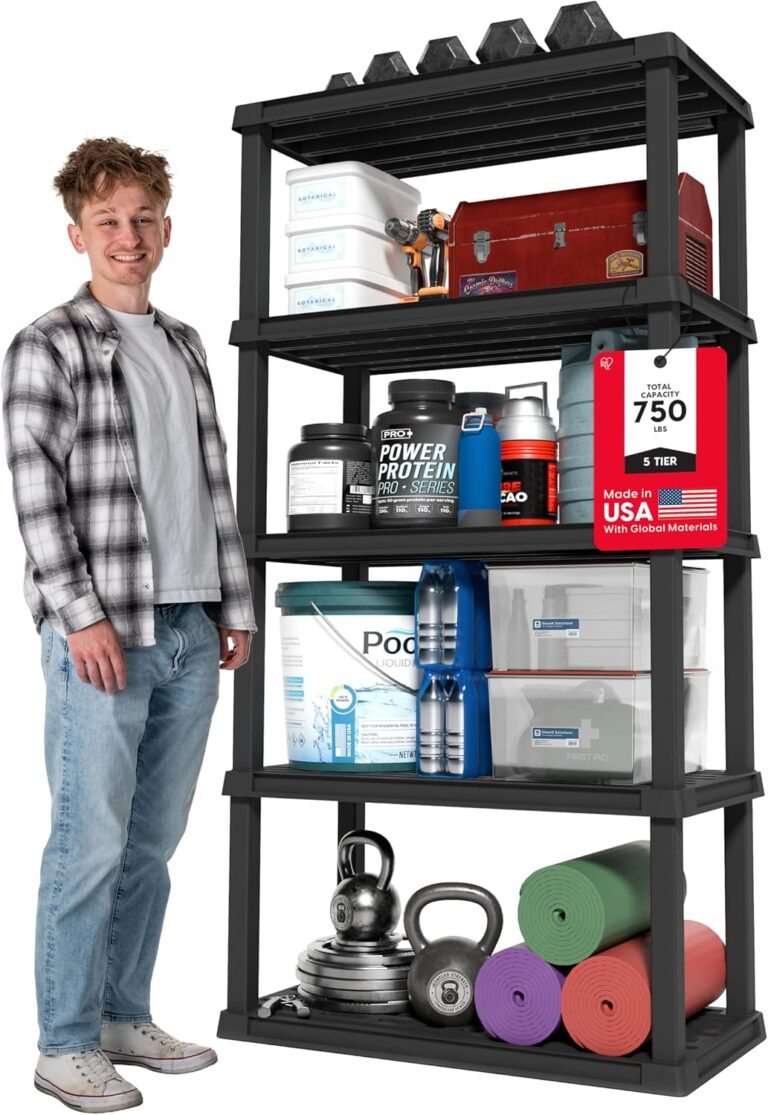 Objects shown to illustrate use are not a statement of included accessories; see the model and variant details. | 510032 Black / 36 × 18 × 73 in | Check the load rating and weight distribution for each shelf. Measure vertical clearance and follow any wall-securing instructions, especially when storing heavier objects. |
Seville Classics WEB675 shelving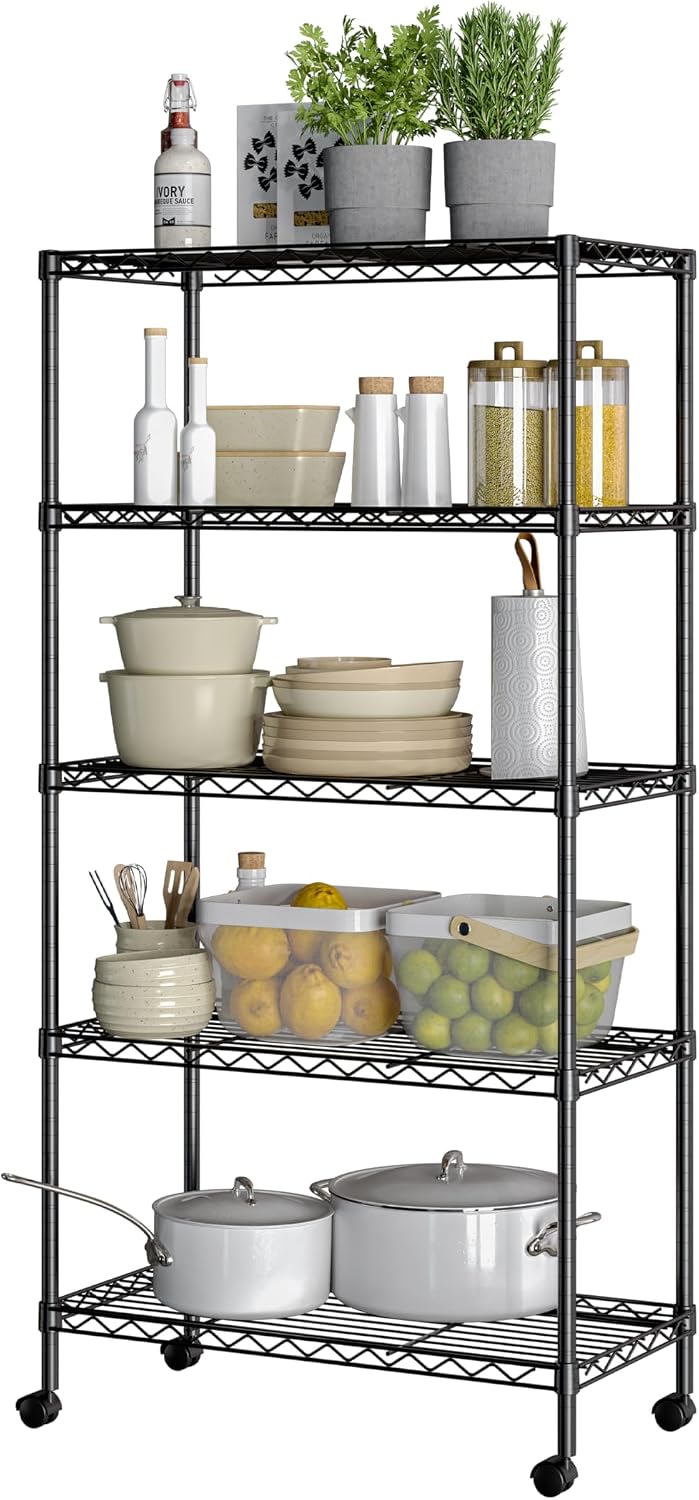 Objects shown to illustrate use are not a statement of included accessories; see the model and variant details. | WEB675 Black / five tiers / 30 × 14 in footprint | Confirm assembled height before planning a tight space: the original article stated 60 inches, while the current listing states 61.5. Check shelf load and leveling requirements rather than combining dimensions from another kit. |
Product Guides
Amazon Basics five-shelf rolling rack
A black wire shelving unit with five adjustable shelves and four-inch casters. This version measures 30 × 14 × 64.75 inches, providing movable storage rather than a fixed built-in cabinet.
Variant: Black / 30 × 14 × 64.75 in / casters
Distinguish stationary capacity from the allowed load on wheels. Check floor conditions, overhead clearance and the instructions for distributing weight before moving a loaded rack.
View product details →View on AmazonObjects shown to illustrate use are not a statement of included accessories; see the model and variant details.
Seville Classics WEB675 shelving
A black five-tier steel wire shelving unit with a 30 × 14 inch footprint. Adjustable shelves provide open utility storage without the solid sides of a cabinet.
Variant: Black / five tiers / 30 × 14 in footprint
Confirm assembled height before planning a tight space: the original article stated 60 inches, while the current listing states 61.5. Check shelf load and leveling requirements rather than combining dimensions from another kit.
View product details →View on AmazonObjects shown to illustrate use are not a statement of included accessories; see the model and variant details.
IRIS USA five-shelf storage unit
A black plastic shelving unit with five shelves, measuring 36 inches wide, 18 deep and 73 high. Its open format is intended for utility storage rather than enclosed display.
Variant: Black / 36 × 18 × 73 in
Check the load rating and weight distribution for each shelf. Measure vertical clearance and follow any wall-securing instructions, especially when storing heavier objects.
View product details →View on AmazonGarage Storage Buyer Guide
Getting started: floor first, then walls
The most immediate garage improvement for most households is getting items off the floor and onto shelves. Freestanding shelving units do this without any wall work, making them the practical first step. Once the floor is clear, you can evaluate whether additional wall space, cabinet storage, or overhead systems make sense for your specific garage. Starting with a freestanding unit is low-commitment and provides immediate improvement.
How to organize a garage shelf efficiently
Organize by frequency of use: items used weekly (tools, sports equipment, everyday supplies) should be at eye level and within easy reach. Items used monthly (seasonal supplies, automotive supplies) can go on upper or lower shelves. Items used yearly (holiday decorations, seasonal gear) can go on the highest or lowest shelf. This top-to-bottom frequency approach reduces the number of times you have to move things to find what you need.
Matching shelf depth to what you're storing
A 14-inch deep shelf works well for tools, small bins, and items that stand on their own. An 18-inch deep shelf accommodates larger storage containers, bulk supplies, and oversized items. Measure the depth of the typical bin or container you plan to store before choosing a shelf depth — a bin that’s slightly deeper than the shelf will overhang and become inconvenient over time.
When to consider modular units
If you anticipate needing more storage within a year or two — because of a growing household, new hobbies, or expanding seasonal storage — a modular plastic unit that accepts side-by-side expansion is a practical investment. Starting with one unit and adding a second later costs no more than buying two units at once, but keeps the initial outlay lower while the storage need is still being evaluated.
Frequently Asked Questions
What type of shelving works best in a garage?
Freestanding metal wire shelving units are a practical choice for most garages because they assemble without tools, adjust to different heights, and allow air circulation around stored items. Plastic shelving units work well if you want a lighter option that resists rust in humid garages. For garages where you frequently rearrange items, a rolling unit with casters gives you the flexibility to reposition without disassembling.
How many shelves do I need for a garage?
A 5-shelf unit is the most versatile starting point for most garages. It provides five distinct levels for different categories — tools, seasonal items, automotive supplies, sports equipment, and household overflow — while staying within a manageable footprint. If your garage has limited wall space, two or three narrow units along a single wall can be more practical than one very wide unit.
Do I need to secure freestanding garage shelves to the wall?
Most freestanding garage shelving units include leveling feet that keep them stable on standard garage floors without wall attachment. Refer to the manufacturer’s product documentation for guidance specific to each unit. For typical residential garage use on a level concrete floor, leveling feet are generally sufficient for stable, everyday use.
What is the advantage of wire shelving over solid shelf shelving in a garage?
Wire shelving allows air to circulate around stored items, which is useful in garages where temperature and humidity fluctuate. It also lets you see items from multiple angles without bending over. The open design means dust and debris fall through rather than accumulating on the shelf surface. Solid shelf units are easier to clean if you store items that shed small debris, but wire shelving is generally preferred for garage use because of the ventilation and visibility benefits.