Best Closet Organizers: Hanging Shelves, Freestanding Units, and Shoe Storage
The best closet organizers for any size closet — hanging fabric shelves, stackable units, and shoe storage. Practical guide for renters and homeowners without fake ratings.
In this guide
Affiliate Disclosure:
As an Amazon Associate I earn from qualifying purchases. We do not display live prices, ratings, or availability. This does not affect which products we recommend — our picks are based on research, use cases, and reader needs.
Who This Guide Is For
This guide is for anyone dealing with an overcrowded, disorganized, or underutilized closet — whether it’s a small reach-in bedroom closet, a shared family closet, or a larger walk-in that still somehow never has enough space. We focus on products that work without permanent installation, so both renters and homeowners can benefit.
We cover three distinct product types: hanging fabric shelves (which add shelf space within the hanging rod zone), freestanding stackable units (which provide open shelf storage anywhere), and hanging shoe organizers (which get footwear off the floor and visible). These three types solve the most common closet problems without requiring any drilling or landlord involvement.
How We Chose These Products
We research, compare, and explain products based on use cases, specifications, public product information, and buyer needs. For closet organizers, our focus was on products that: solve specific closet problems without permanent modification, are genuinely useful for multiple household types (renters, families, small apartments), and come from brands with established availability. We prioritized functional variety — one hanging organizer, one freestanding unit, and one shoe organizer — over listing multiple similar products from the same category.
Things to Know Before You Buy
Hanging vs. freestanding: know which type you need first
These are fundamentally different products. Hanging fabric organizers attach to your closet rod and add shelf space in the vertical zone below or beside your hanging clothes — they do not replace a rod and cannot exist without one. Freestanding shelf units sit on the floor and work anywhere regardless of whether a rod exists. Shoe organizers that hang from a rod are a third type: they replace floor space with vertical hanging space.
Renters: non-destructive options exist
All three types covered in this guide require zero drilling. Hanging organizers use a simple strap over the rod. Freestanding units sit on the floor. No holes, no anchors, no landlord conversations required. If you eventually move, everything removes in minutes.
Weight limits matter more than you think
Hanging fabric shelves have a weight limit that’s lower than it looks — they’re designed for folded clothes, accessories, and bags, not heavy items. Overloading a hanging organizer will cause it to sag and eventually pull down on the rod. Check the product’s stated weight limit before stuffing it with heavy sweaters or shoes.
Stackable freestanding units work best on level surfaces
Stackable wire or plastic shelf units need to be on a flat, level floor to sit correctly. Carpeted closets or uneven surfaces can cause stacking instability. For carpeted closets, a single unit without stacking is usually more stable and safer than stacking two units.
Quick Picks — Comparison Table
Product | Model & variant | Choosing |
|---|---|---|
ClosetMaid 1565 five-shelf organizer | 1565 White / five shelves | Measure both the unit and the objects that must fit between its shelves. Follow the manufacturer's assembly and stacking instructions rather than treating several units as one secured cabinet. |
Simple Houseware ten-shelf shoe organizer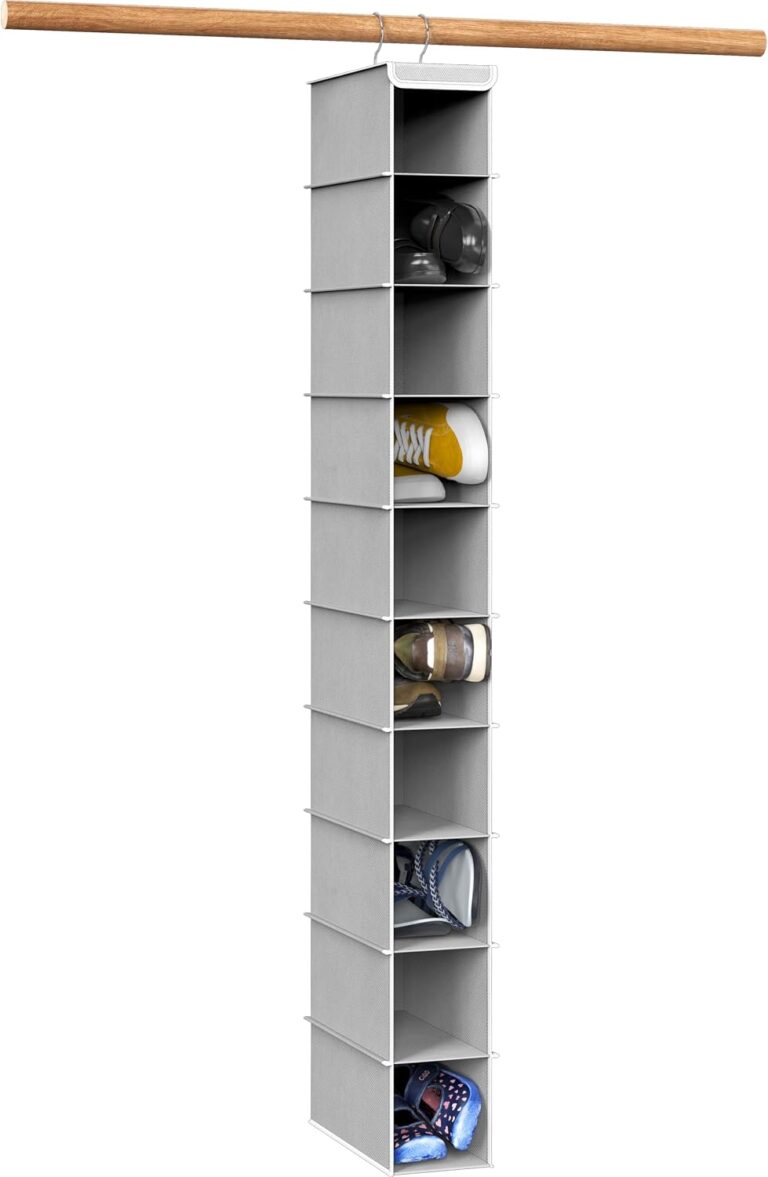 Objects shown to illustrate use are not a statement of included accessories; see the model and variant details. | BO-017-2 Grey / one ten-shelf organizer | Check the hanging length and compartment size against your shoes. The closet rail must support the loaded organizer along with anything else hanging from it. |
Simple Houseware five-shelf hanging organizer Objects shown to illustrate use are not a statement of included accessories; see the model and variant details. | BO-004-2 Grey / five shelves | Measure the free rail length and vertical clearance. Distribute the load and follow the stated support limits; fabric shelves are not rigid cabinet shelves. |
Product Guides
Objects shown to illustrate use are not a statement of included accessories; see the model and variant details.
Simple Houseware five-shelf hanging organizer
A grey hanging closet organizer with five shelves, dual hooks and side mesh pockets. It provides wider compartments than a narrow ten-shelf shoe organizer.
Variant: Grey / five shelves
Measure the free rail length and vertical clearance. Distribute the load and follow the stated support limits; fabric shelves are not rigid cabinet shelves.
View product details →View on AmazonClosetMaid 1565 five-shelf organizer
A white five-shelf organizer in the ClosetMaid 1565 format. It offers narrow open compartments for arranging shoes and other small items inside a storage area.
Variant: White / five shelves
Measure both the unit and the objects that must fit between its shelves. Follow the manufacturer's assembly and stacking instructions rather than treating several units as one secured cabinet.
View product details →View on AmazonObjects shown to illustrate use are not a statement of included accessories; see the model and variant details.
Simple Houseware ten-shelf shoe organizer
A grey hanging organizer with ten vertical compartments and two metal hooks. It uses hanging-rail space rather than occupying the closet floor.
Variant: Grey / one ten-shelf organizer
Check the hanging length and compartment size against your shoes. The closet rail must support the loaded organizer along with anything else hanging from it.
View product details →View on AmazonCloset Organization Buyer Guide
Assessing your closet before buying anything
Before purchasing any organizer, spend 10 minutes with your current closet. What’s taking up the most space? What do you reach for most often? What’s on the floor that shouldn’t be? The answers usually reveal whether you need more shelf space (hanging organizer or freestanding unit), better floor management (shoe organizer or bins), or simply a declutter session before any organization products will help.
The difference hanging space makes
In a standard reach-in closet, the hanging zone below the rod is usually underused. A hanging fabric organizer converts that dead zone into multiple usable shelves. If you don’t have many long items to hang (dresses, full-length coats), a double-hang rod extender paired with a shelf organizer can effectively double your closet’s storage capacity with no installation required.
Matching organizer type to household
Shared household closets benefit most from clear, category-based systems where each person’s items have a defined zone. Kids’ closets benefit from low-height storage that children can reach independently — a freestanding short shelf unit or a low-hanging organizer rather than high shelves that require adult help for everything. Single-occupant apartments often benefit most from maximizing vertical space with a full-height freestanding unit.
Building out over time
You don’t need to buy everything at once. Start with the product that addresses your most frustrating closet problem. Once that’s in place and working, you’ll have a much clearer view of what else might help. Over-purchasing closet organizers and installing a complex system all at once often results in a system that doesn’t match actual use patterns.
Frequently Asked Questions
What is the easiest closet organizer to install?
Hanging closet organizers are the easiest — zero tools required, and they take about 30 seconds to hang from an existing rod. Freestanding shelf units are the next easiest, requiring only basic assembly. Both types work without drilling or landlord permission.
Can I use closet organizers in a rental?
Yes — all three products in this guide require zero wall modifications. Hanging organizers attach to your existing rod. Freestanding units sit on the floor. Both remove completely when you move. Wall-mounted track systems require drilling and are better suited for homeowners.
How do I decide between a hanging organizer and a freestanding unit?
Hanging organizers work best when your closet has a strong rod and you have hanging space to spare — they add shelf space within the hanging zone. Freestanding units work best when you need shelf storage independent of a hanging rod, or in a space without a closet rod at all.
How many pairs of shoes does a 10-shelf hanging organizer hold?
Approximately 10 pairs of everyday footwear — one pair per shelf. Larger shoes or boots may take more shelf space; very flat sandals or flats can sometimes share a shelf. The main advantage is keeping shoes visible and off the floor.