Best Toaster Ovens for Small Kitchens: Compact, Air Fryer Combo, and Space-Saving Picks for 2026
The best toaster ovens for small kitchens in 2026 — compact, air fryer combo, and space-saving picks. Honest guide: no fake ratings, no sponsored rankings.
In this guide
Affiliate Disclosure:
As an Amazon Associate I earn from qualifying purchases. Product images shown may be representative lifestyle photos unless official product images are available through an approved Amazon data source. We do not display live prices, ratings, or availability.
Representative kitchen image — view exact product photos on Amazon.
Who This Guide Is For
This guide is for people with limited counter space who want a capable countertop oven for everyday cooking — reheating, toasting, baking small dishes, and roasting. We focus on compact models that deliver real performance without demanding half the counter.
We are not covering full-size countertop convection ovens, commercial units, or large toaster ovens designed for families of 6. If you cook for 1–4 people and want something that fits comfortably in a small kitchen, these are the right picks.
How We Chose These Toaster Ovens
We researched, compared, and explain products based on use cases, specifications, public product information, and buyer needs. Our selection criteria for small-kitchen toaster ovens:
Physical footprint: Width, depth, and door-open clearance — all measured against real small-kitchen countertop constraints.
Heating technology: Radiant, convection, infrared — how quickly the oven reaches temperature and how evenly it cooks.
Versatility for the footprint: Does the unit do more than toast? Baking, broiling, and air frying add value in a small kitchen where every appliance must justify its space.
Ease of cleaning: Crumb trays, removable racks, and non-stick interiors matter for daily use.
Category-proven models: Established products with track records, not first-generation releases.
5 Things to Know Before You Buy a Toaster Oven for a Small Kitchen
Toaster Oven Buyer's Checklist
Measure your counter space before buying — including the door swing. A standard toaster oven door swings outward and needs 12–18 inches of clearance in front of the unit. The Hamilton Beach 31127D’s roll-top door solves this for tight spots where a standard swing door would hit a drawer or wall.
Infrared heating is faster than standard coil elements. The Panasonic FlashXpress uses double infrared heating and reaches temperature almost instantly — noticeably faster than standard toaster ovens. For households that use the oven for quick meals, this difference is felt every day.
An air fryer toaster oven replaces two appliances. The Cuisinart TOA-60 adds a high-speed convection fan that mimics air frying. If you want air frying capability and don’t already own an air fryer, this combination unit eliminates the need for a separate appliance and saves counter space overall.
Interior capacity determines what you can actually cook. A 4-slice capacity handles standard toast slices, a 9-inch pizza, and small casseroles. A 6-slice capacity handles a 12-inch pizza and more. Know what you’ll cook most often before choosing a size.
Auto shutoff is a practical safety feature, not a gimmick. If you’re reheating food and get distracted, auto shutoff prevents a burning meal. The Hamilton Beach 31127D has auto shutoff. Check for this feature if your kitchen multitasking is frequent.
Quick Comparison Table
Product | Model & variant | Choosing |
|---|---|---|
Panasonic FlashXpress NB-G110P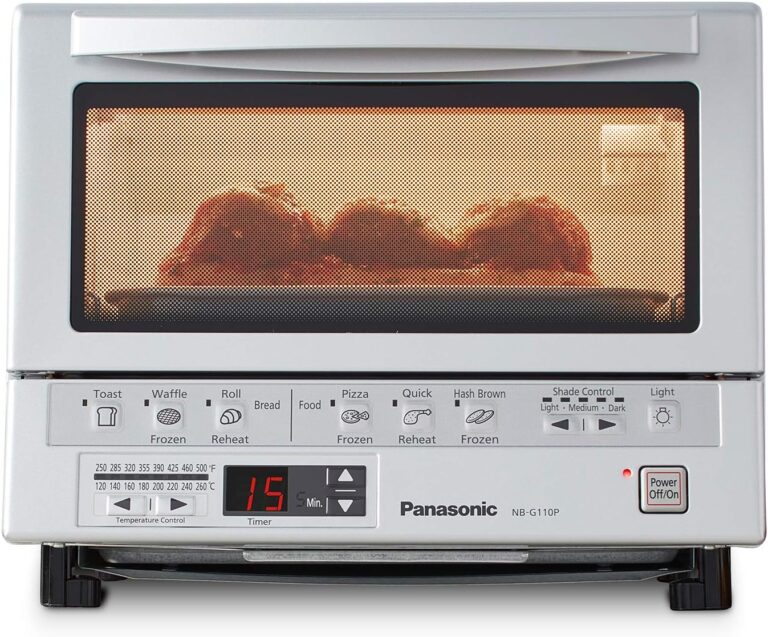 Objects shown to illustrate use are not a statement of included accessories; see the model and variant details. | NB-G110P Silver / four-slice | Check that your bread, baking dishes and usual portions fit the small cavity. Leave the clearances specified in the manual; compact external dimensions do not remove ventilation requirements. |
Cuisinart TOA-60 air-fryer oven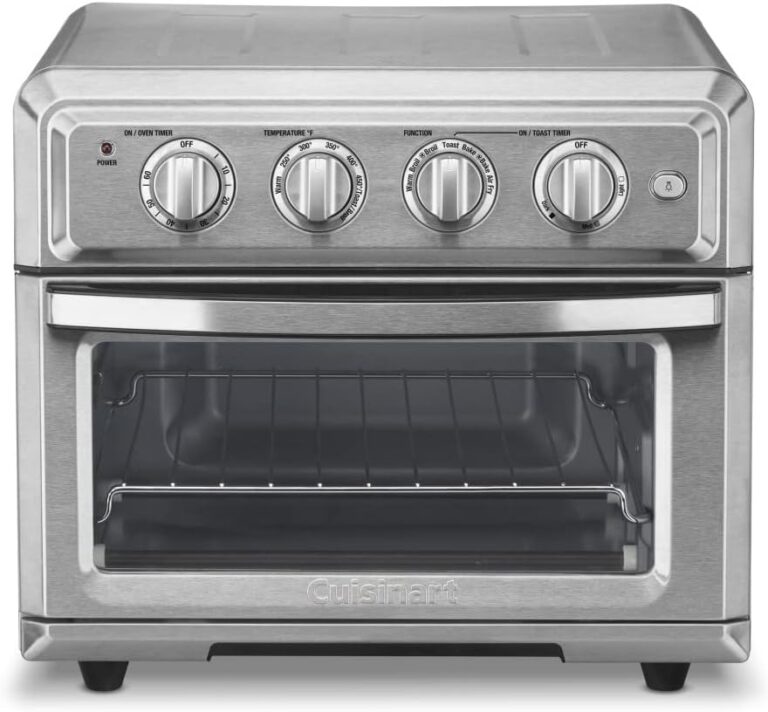 | TOA-60 Stainless steel / TOA-60 | Check the exact model and included racks and trays if offered by a seller. Do not apply accessories or specifications from a TOA-65, TOA-70 or a colored TOA-60 variant without confirmation. |
Hamilton Beach 31127D Easy Reach oven The pizza illustrates use and is not included. | 31127D Silver / six-slice / roll-top door | Check clearance around the hot oven and the size of your baking pan. This is the Easy Reach model with three cooking functions; the original Sure-Crisp label was inaccurate. It is not presented as an air fryer. |
Our Top Picks for 2026
Objects shown to illustrate use are not a statement of included accessories; see the model and variant details.
Panasonic FlashXpress NB-G110P
A compact four-slice toaster oven with double infrared heating and six automatic cooking options. This listing identifies the silver NB-G110P, rather than a larger countertop oven.
Variant: Silver / four-slice
Check that your bread, baking dishes and usual portions fit the small cavity. Leave the clearances specified in the manual; compact external dimensions do not remove ventilation requirements.
View product details →View on AmazonCuisinart TOA-60 air-fryer oven
A stainless-steel countertop oven combining convection cooking and air frying.
Variant: Stainless steel / TOA-60
Check the exact model and included racks and trays if offered by a seller. Do not apply accessories or specifications from a TOA-65, TOA-70 or a colored TOA-60 variant without confirmation.
View product details →View on AmazonThe pizza illustrates use and is not included.
Hamilton Beach 31127D Easy Reach oven
A countertop oven for toast, baking and broiling. Its door rolls upward, which makes access different from a conventional drop-down door. Manual dials suit straightforward cooking without app controls.
Variant: Silver / six-slice / roll-top door
Check clearance around the hot oven and the size of your baking pan. This is the Easy Reach model with three cooking functions; the original Sure-Crisp label was inaccurate. It is not presented as an air fryer.
View product details →View on AmazonBuyer's Guide: Choosing a Toaster Oven for a Small Kitchen
Compact vs. Standard vs. Air Fryer Combo: What Type Do You Actually Need?
The first decision is what you primarily need the appliance to do:
Just toasting and reheating quickly: A compact 4-slice model like the Panasonic FlashXpress is the right choice — it takes up the least space and does the job faster than larger units.
Baking, broiling, and toasting: A standard 6-slice model like the Hamilton Beach 31127D handles these tasks and fits most small kitchens.
Air frying + toasting + baking in one footprint: The Cuisinart TOA-60 is larger than a basic toaster oven but replaces a separate air fryer, resulting in net counter space savings if you currently own or would buy both separately.
Heating Technologies: Radiant, Convection, and Infrared
Standard toaster ovens use radiant heat from coil elements top and bottom. Convection adds a fan that circulates hot air for faster, more even results — particularly noticeable for baking cookies and roasting vegetables. Infrared, used by the Panasonic FlashXpress, heats from the inside out at the molecular level rather than heating the air in the chamber first. The practical result is noticeably faster preheating and cooking times.
For everyday small-kitchen use, the difference between convection and radiant matters most for baking. For reheating and toast, any of these technologies works well.
The Roll-Top Door: A Practical Solution for Tight Spaces
Most toaster oven doors swing outward and down, requiring the user to step back and creating a hot surface at knee level during cooking. The Hamilton Beach Easy Reach’s roll-top door eliminates both problems — it retracts upward without projecting outward, and the hot door surface is contained within the unit’s footprint. For kitchens with upper cabinets positioned low, islands within arm’s reach, or drawers positioned right next to the oven, this is the specific problem this design solves.
Tip: The countertop power issue in older apartments.
Many older apartments and studio kitchens have limited outlet availability on the countertop. If your available outlets are already shared with a coffee maker, microwave, or blender, confirm the circuit capacity before adding a 1,200–1,800 watt toaster oven to the same circuit. Most kitchens have at least two dedicated 20-amp circuits, but older construction may not.
Frequently Asked Questions
What size toaster oven do I need for a small kitchen?
For a small kitchen, a compact 4-slice toaster oven is the right starting point — it measures roughly 12–15 inches wide and fits comfortably on most countertops without dominating the space. The Panasonic FlashXpress is one of the smallest capable units available. If you want air frying capability in the same footprint, the Cuisinart TOA-60 is larger but replaces two appliances. If the door swing is your constraint, the Hamilton Beach 31127D’s roll-up door solves that specific problem.
Is a toaster oven more efficient than a full-size oven?
Yes, for small quantities. A toaster oven heats a much smaller chamber — it reaches cooking temperature in 3–5 minutes versus 10–15 minutes for a full oven, uses 1,200–1,800 watts versus 2,400–5,000 watts for a full oven, and doesn’t heat the surrounding kitchen as much. For cooking for 1–4 people, a toaster oven is the practical choice for most everyday tasks. Full ovens make more sense for large roasts, multiple casserole dishes, or anything that requires 5+ servings simultaneously.
What is the difference between a toaster oven and an air fryer toaster oven?
A standard toaster oven uses radiant heat from top and bottom elements. An air fryer toaster oven adds a high-speed convection fan that circulates hot air rapidly around the food, creating a crisping effect similar to deep frying. The air fryer function is particularly useful for frozen foods, chicken wings, and vegetables where a crispy exterior is the goal. If you already own an air fryer, a standard toaster oven may be sufficient. If you’re choosing just one countertop appliance, an air fryer toaster oven combines both functions.
Can I bake in a small toaster oven?
Yes — most toaster ovens bake well for small quantities. The Cuisinart TOA-60 handles a 12-inch pizza and standard 9×13 baking pan. The Panasonic FlashXpress is smaller but handles 4 slices of toast, a small casserole, or a 9-inch pizza. Baking results are generally comparable to a full oven for single-layer items; layer cakes and tall roasts are better suited to a full oven due to space constraints.
How do I choose between convection and standard heating in a toaster oven?
Convection adds a fan that circulates hot air for faster, more even cooking — it’s particularly useful for baking cookies, roasting vegetables, and cooking chicken. Standard radiant heat is simpler and works well for toast, reheating, and basic baking. The Panasonic FlashXpress uses infrared heating, which is faster than both — it reaches temperature almost instantly. If even browning and faster cooking matter, choose a convection or infrared model. If you primarily make toast and reheat food, a simpler standard model is fine.