Best Rice Cookers for Families: Budget, Micom, and Fuzzy Logic Picks for 2026
The best rice cookers for families in 2026 — budget, Micom, and fuzzy logic picks for households that cook rice regularly. Honest guide with no fake ratings.
In this guide
Affiliate Disclosure:
As an Amazon Associate I earn from qualifying purchases. Product images shown may be representative lifestyle photos unless official product images are available through an approved Amazon data source. We do not display live prices, ratings, or availability.
Representative kitchen image — view exact product photos on Amazon.
Who This Guide Is For
This guide is for families who cook rice regularly — at least a few times a week — and want a dedicated appliance that produces consistent results with minimal attention. We cover models suitable for households of 3–6 people, with options across budget, mid-range, and quality-focused tiers.
We are not covering induction heating (IH) rice cookers, commercial units, or very small 1–2 person models. If you cook primarily white rice for a family, all three picks work. If you also cook brown rice, mixed grains, or want slow cooking capability, the specific features of each model become more relevant — we cover those differences in the buyer’s guide below.
How We Chose These Rice Cookers
We research, compare, and explain products based on use cases, specifications, public product information, and buyer needs. Our selection criteria:
Capacity for family-size cooking: Appropriate for 3–6 person households, not designed for single servings.
Rice variety support: Can the cooker handle brown rice, sushi rice, and other grain types beyond basic white rice?
Keep-warm function: Holds cooked rice at a safe serving temperature for families with variable mealtimes.
Ease of cleaning: Removable inner pot, dishwasher-safe components where applicable.
Established models: Category-proven products with track records for reliability.
5 Things to Know Before You Buy a Rice Cooker for Your Family
Rice Cooker Buyer's Checklist
Capacity is listed in uncooked rice — not cooked. A 5.5-cup (uncooked) rice cooker produces approximately 10–11 cups of cooked rice. A 6-cup (uncooked) model is appropriate for families of 4–6. An 8-cup (cooked / 4-cup uncooked) model like the Aroma ARC-994SB uses a different capacity labeling — check the specs carefully.
Fuzzy logic produces more consistent results for varied rice types. If your family cooks brown rice, sushi rice, or mixed grains alongside white rice, a fuzzy logic model adjusts cooking parameters automatically. A basic on/off rice cooker works reliably for white rice but produces inconsistent results for other varieties.
Keep-warm is not the same as extended storage. Most rice cookers keep cooked rice warm safely for 4–8 hours. Beyond that, rice quality degrades and food safety becomes a concern. The Zojirushi NS-TSC10 and Toshiba TRCS01 both have timed keep-warm functions. Do not use keep-warm as multi-day storage.
The inner pot material affects durability. Nonstick inner pots are easier to clean but the coating wears over time with metal utensils. Use silicone or wooden utensils inside the pot to extend coating life. The Zojirushi NS-TSC10’s inner pot is known for durability.
A delay timer is genuinely useful for busy households. The Toshiba TRCS01 has two delay timers. You can add rice and water before leaving home and set the cooker to finish at dinnertime. The Zojirushi NS-TSC10 also includes a delay timer.
Quick Comparison Table
Product | Model & variant | Choosing |
|---|---|---|
Zojirushi NS-TSC10 rice cooker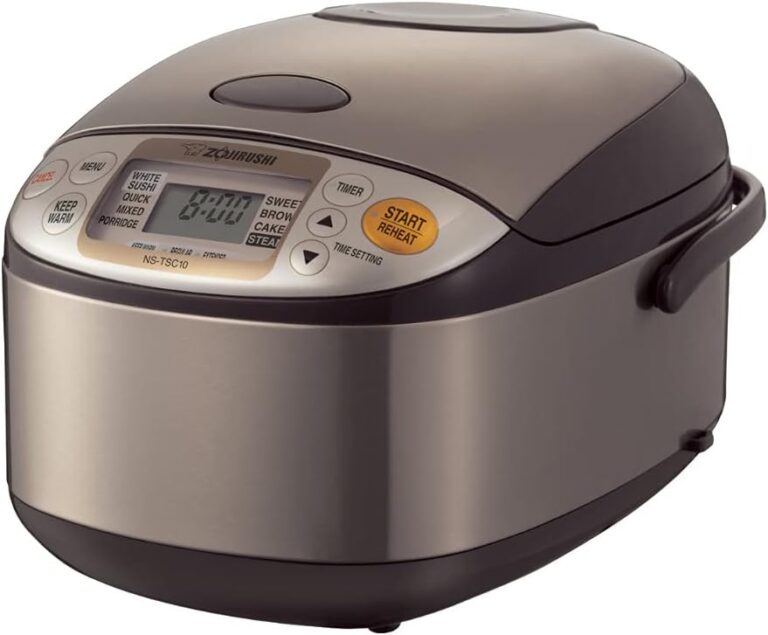 | NS-TSC10 NS-TSC10 / 5.5 cups uncooked | Use the supplied measure and the pot markings together. Check the counter height for opening the lid and the portions you actually prepare before choosing this size. |
Toshiba TRCS01 rice cooker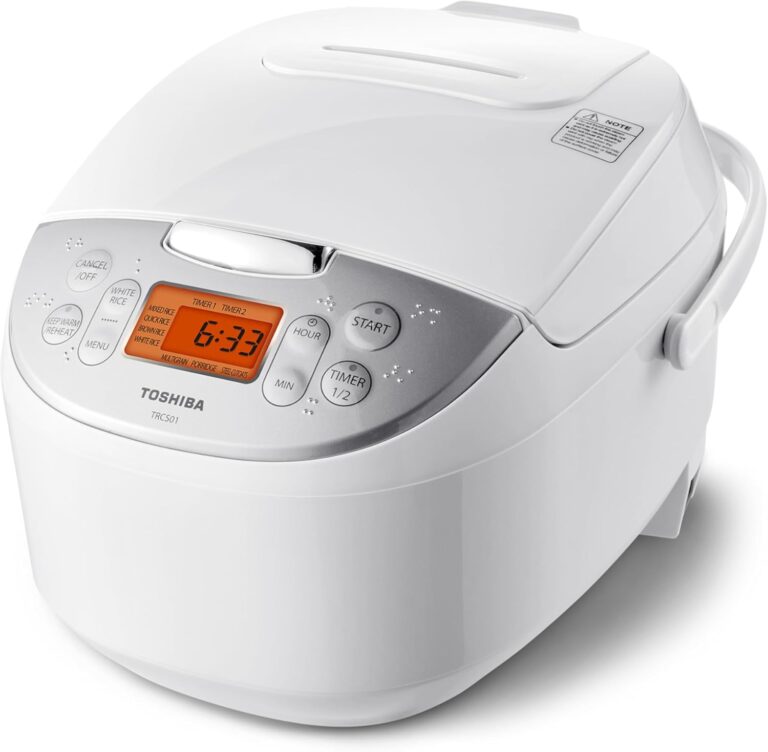 | TRCS01 White / 6 cups uncooked | Distinguish uncooked capacity from the volume after cooking. Use the supplied cup and fill markings, and account for access to remove and clean the inner pot. |
Aroma ARC-994SB rice cooker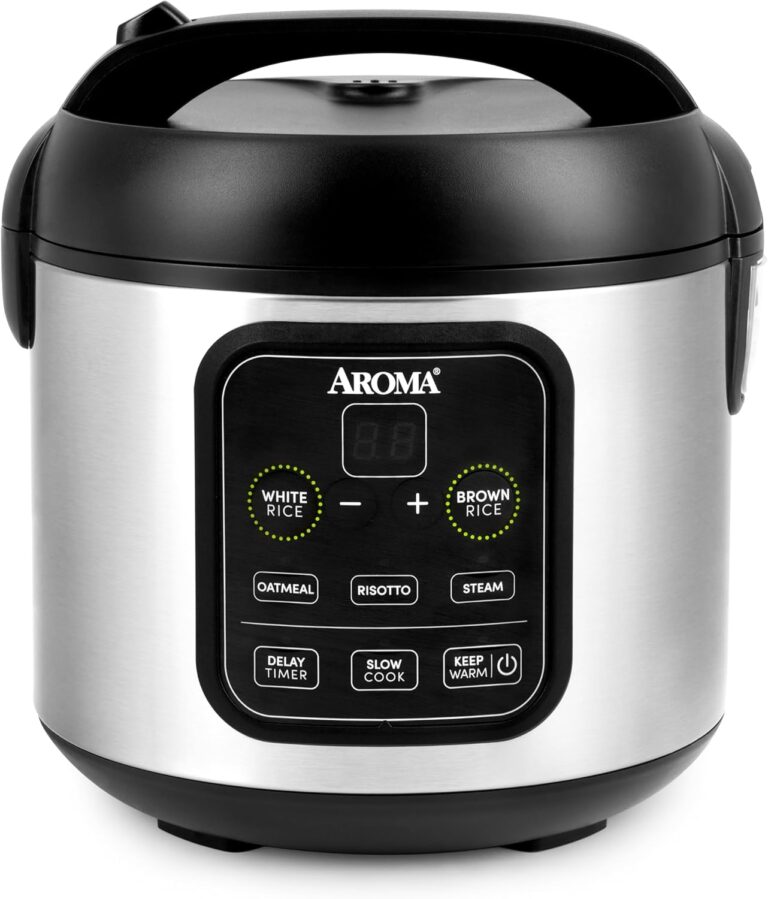 | ARC-994SB Stainless finish / 4 cups uncooked | Use the uncooked capacity when comparing it with a 5.5- or 6-cup rice cooker. Check the recipe-specific filling limits rather than treating the cooked-rice figure as a raw-ingredient allowance. |
Our Top Picks for 2026
Zojirushi NS-TSC10 rice cooker
A Micom rice cooker and warmer with a 5.5-cup uncooked-rice capacity. The supplied rice cup is the reference for filling; this is not a 5.5-cup serving capacity.
Variant: NS-TSC10 / 5.5 cups uncooked
Use the supplied measure and the pot markings together. Check the counter height for opening the lid and the portions you actually prepare before choosing this size.
View product details →View on AmazonAroma ARC-994SB rice cooker
A rice and grain cooker rated for four cups uncooked or eight cups cooked. This 2 qt ARC-994SB also lists steam and slow-cook functions in a compact countertop format.
Variant: Stainless finish / 4 cups uncooked
Use the uncooked capacity when comparing it with a 5.5- or 6-cup rice cooker. Check the recipe-specific filling limits rather than treating the cooked-rice figure as a raw-ingredient allowance.
View product details →View on AmazonToshiba TRCS01 rice cooker
A rice cooker with fuzzy-logic control, seven cooking functions and capacity for six supplied measures of uncooked rice. The TRCS01 uses a nonstick inner pot and includes a steaming basket.
Variant: White / 6 cups uncooked
Distinguish uncooked capacity from the volume after cooking. Use the supplied cup and fill markings, and account for access to remove and clean the inner pot.
View product details →View on AmazonBuyer's Guide: Rice Cooker Features That Actually Matter for Families
Capacity: How Much Rice Do You Actually Need?
Rice cooker capacity is typically listed in cups of uncooked rice. One cup of uncooked rice produces roughly 2 cups of cooked rice. Here’s the practical guide for family cooking:
2–3 people (rice as side dish): 3-cup uncooked capacity is sufficient for most meals.
3–5 people: 5.5-cup uncooked (Zojirushi NS-TSC10) produces enough cooked rice for 4–6 portions.
4–6 people or rice as a main dish: 6-cup uncooked (Toshiba TRCS01) or the Aroma ARC-994SB (which labels capacity in cooked cups at 8 cups cooked / 4 cups uncooked).
Fuzzy Logic vs. Basic: Does It Actually Make a Difference?
For white rice exclusively, a basic rice cooker works fine — the simple thermostat approach produces reliable results for long-grain and medium-grain white rice. The difference becomes clear with brown rice, sushi rice, and mixed grains. Brown rice requires longer cooking at different temperatures; a basic cooker either undercooks or overcooks it depending on the water ratio. Fuzzy logic models like the Zojirushi and Toshiba TRCS01 handle these varieties automatically with dedicated settings.
The Delay Timer: Underrated Quality-of-Life Feature
A delay timer lets you add rice and water in the morning and set the cooker to finish at dinnertime. For families where one parent arrives home while managing children, homework, and meal prep simultaneously, having rice already done and kept warm when they walk through the door is a genuine time-saver. Both the Zojirushi NS-TSC10 and Toshiba TRCS01 include delay timers; the Aroma ARC-994SB does not.
Multi-Function Value: When One Appliance Does More
The Aroma ARC-994SB adds slow cooking and steaming to rice cooking. For a household that already owns a slow cooker, this is redundant. For a household that doesn’t, the Aroma provides the functionality of both appliances in one unit. The steam tray is genuinely useful for weeknight cooking — vegetables and proteins steam above while rice cooks below, producing a complete side dish simultaneously.
Tip: Use the water line markings, not generic ratios.
Every rice cooker includes water line markings on the inner pot specific to that model’s calibration. Rice-to-water ratios vary by brand, elevation, and rice type. Using the markings on the specific cooker you own produces better results than applying a generic 1:2 ratio from a recipe. Most cooking inconsistency with rice cookers comes from ignoring the model’s own water lines.
Frequently Asked Questions
What size rice cooker do I need for a family of 4?
For a family of 4 eating rice as a side dish, a 5.5-cup (uncooked) rice cooker is the practical minimum. This produces enough cooked rice for 4–6 portions depending on serving size. For families that eat rice as a main dish or for larger households (5–6 people), an 8-cup (cooked) model like the Aroma ARC-994SB is better suited. The Toshiba TRCS01 at 6-cup (uncooked) is a good middle ground for families of 4–6.
What is the difference between a basic rice cooker and a fuzzy logic rice cooker?
A basic rice cooker uses a simple thermostat — it switches from cook to warm when the internal temperature reaches a set point. This works well for white rice but produces inconsistent results with brown rice, sushi rice, and mixed grains. A fuzzy logic rice cooker uses microcomputer (Micom) control to monitor temperature throughout the cooking cycle and adjust in real time. The result is more consistent texture across rice varieties. Zojirushi and Toshiba’s TRCS01 both use fuzzy logic. For households that primarily cook white rice, a basic model works fine. For varied grain cooking, fuzzy logic makes a practical difference.
Can I cook other things besides rice in a rice cooker?
Yes, especially in multi-function models. The Aroma ARC-994SB has slow cook, steam, and oatmeal functions in addition to rice cooking. You can steam vegetables and fish using the included steam tray while rice cooks below. The Toshiba TRCS01 handles porridge, oatmeal, and mixed grains beyond white and brown rice. The Zojirushi NS-TSC10 is more focused on rice varieties but handles quick-cook, regular, mixed, porridge, and sweet rice settings.
How do rice cooker cups compare to standard measuring cups?
Rice cooker cups are typically 180ml — about 3/4 of a standard US measuring cup (240ml). A 5.5-cup rice cooker capacity refers to 5.5 rice cooker cups (about 990ml) of uncooked rice, not 5.5 US cups. This matters when reading capacity specs. A 5.5-cup (uncooked) rice cooker produces approximately 10–11 US cups of cooked rice — more than enough for a family of 4–6 as a side dish.
Is a rice cooker worth it if I only cook rice occasionally?
For households that cook rice 2–3 times per week or more, yes — a rice cooker produces consistently better results than stovetop with less attention required. You add rice and water, press a button, and walk away. The keep-warm function holds cooked rice safely for hours, which is useful for families with varied meal times. For households that cook rice once a week or less, a good saucepan with a tight lid works well enough that a dedicated appliance may not justify the counter space.