Best Dish Drying Racks for Small Kitchens: Compact, Two-Tier, and Roll-Up Picks for 2026
The best dish drying racks for small kitchens in 2026 — compact, two-tier, and roll-up picks. Honest guide: no fake ratings, no sponsored rankings.
In this guide
Affiliate Disclosure:
As an Amazon Associate I earn from qualifying purchases. Product images shown may be representative lifestyle photos unless official product images are available through an approved Amazon data source. We do not display live prices, ratings, or availability.
Representative kitchen image — view exact product photos on Amazon.
Who This Guide Is For
This guide is for people with small kitchens — apartments, studios, galley kitchens, and households with limited counter space — who hand-wash dishes and need a drying solution that doesn’t take over the counter or drain poorly. We cover three distinct approaches: a two-tier fold-flat rack that uses vertical space and stores flat, a compact steel-frame rack with a swivel drain spout for controlled drainage, and a roll-up over-the-sink rack that eliminates counter footprint entirely.
If your kitchen has a full dishwasher that handles all your dishes, this guide is not for you. This is for households that hand-wash regularly and need a practical, space-efficient drying solution. We also link to our Home Organization guides for related kitchen storage and organization picks.
How We Chose These Dish Racks
We research, compare, and explain products based on use cases, specifications, public product information, and buyer needs. Our selection criteria for small-kitchen dish drying racks:
Footprint and space efficiency: We prioritized racks with a small counter footprint, fold-flat storage capability, or over-the-sink designs that use sink space rather than counter space.
Drainage design: A dish rack that puddles water on the counter creates a maintenance problem. We looked for racks with swivel drain spouts, drainboards, or over-sink positioning that avoids counter pooling.
Material durability: Steel frames outlast plastic-coated wire racks at wear points. All three picks use steel construction.
Dish and utensil capacity relative to footprint: A small rack that can only hold 4 plates is not practical for a household that hand-washes regularly. We looked for designs that maximize vertical space to increase capacity without expanding the counter footprint.
Brand track record: OXO, simplehuman, and Surpahs all have documented product lines in kitchen organization — not first-generation releases.
5 Things to Know Before You Buy a Dish Drying Rack
Dish Rack Buyer's Checklist
Measure your available counter space before buying. A “compact” dish rack can still occupy 14–18 inches of counter length. Measure your available counter run between the sink and the nearest obstacle. If you have less than 16 inches, a roll-up over-the-sink rack or a rack that’s specifically listed as small (under 14 inches wide) is the better fit.
Drainage matters more than looks. A rack that sits flat on a counter without directing water to the sink creates standing water under the rack. Look for racks with a drain spout that extends over the sink edge (like the simplehuman Compact’s 360° swivel spout) or racks that sit over the sink so water drains directly. Or choose a rack with a removable drainboard tray that you empty manually (like the OXO Fold Flat).
Two-tier racks multiply capacity without expanding the base footprint. The OXO Fold Flat’s two-tier design handles significantly more dishes than a single-tier rack with the same base width. If you wash a full meal’s worth of dishes at once, the extra tier is the difference between one full load and needing to move and re-stack mid-session.
Roll-up racks work well only when your sink supports them. An over-the-sink roll-up rack needs to span your sink opening and rest on the edges. Measure your sink interior width. The Surpahs 20.5″ x 13.1″ model fits sinks up to 19.5″ wide — check this against your actual sink dimensions before buying.
Coated wire racks wear at the coating over time. Plastic-coated wire racks can develop chips at stress points — particularly around the base feet and tray edges. Once the coating chips, those areas can accumulate grime. The picks in this guide use aluminum (OXO), brushed stainless steel (simplehuman), and silicone-coated stainless wire (Surpahs) — more durable material choices than basic plastic-coated wire alternatives.
Quick Comparison Table
Product | Model & variant | Choosing |
|---|---|---|
Surpahs roll-up dish rack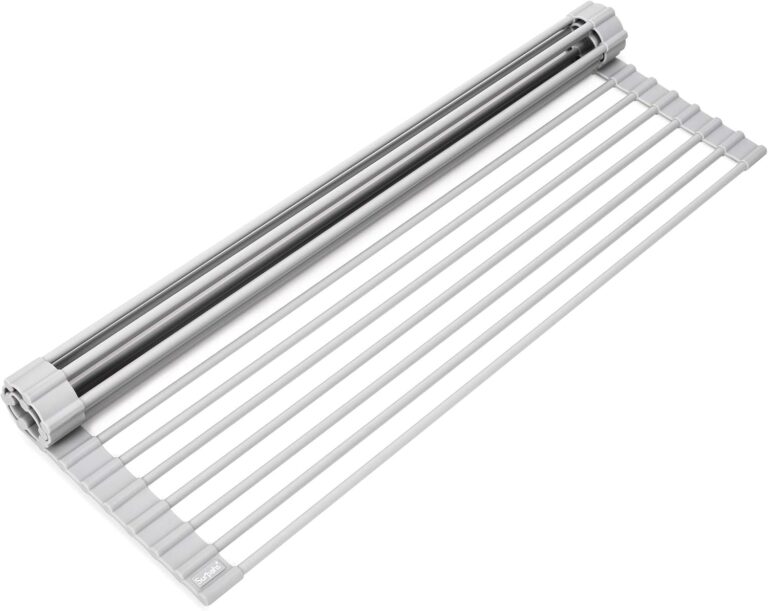 | Roll-Up 20.5 × 13.1 Warm gray / 20.5 × 13.1 in | Measure the open span and the supporting ledges, not just the outside dimensions of the sink. Covering part of the basin also reduces the area available for washing while dishes dry. |
simplehuman compact steel dish rack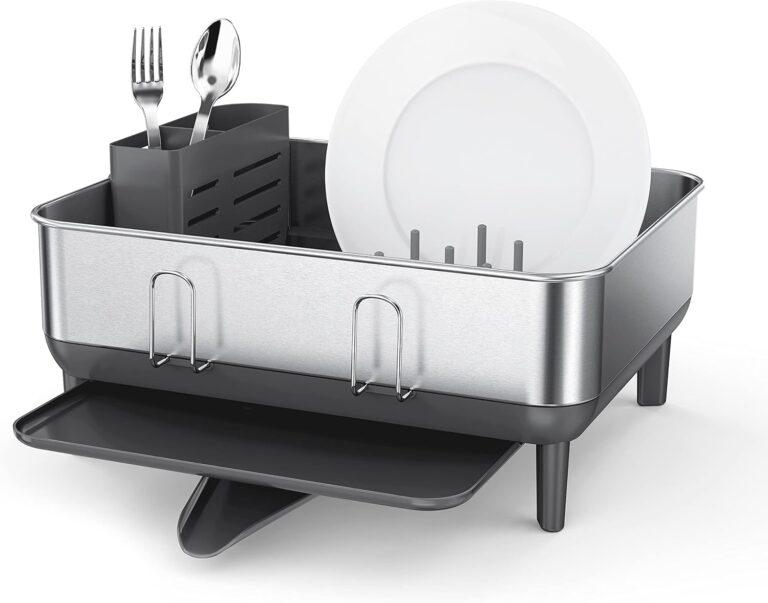 Objects shown to illustrate use are not a statement of included accessories; see the model and variant details. | KT1184DC Brushed stainless steel / compact | Measure the rack footprint and the reach of the drain spout. Check plate and utensil fit; a compact rack can save counter space but may not hold a full family wash-up in one load. |
OXO fold-flat aluminum dish rack | 13322800 Aluminum / two tiers / drainboard | Measure both its open footprint and the space for storing it folded. Check how the upper tier supports your plates and allow the rack to dry before putting it away. |
Our Top Picks for 2026
OXO fold-flat aluminum dish rack
An aluminum dish rack with two tiers and a drainboard that folds flat for storage. It offers a way to recover counter space after dishes have dried.
Variant: Aluminum / two tiers / drainboard
Measure both its open footprint and the space for storing it folded. Check how the upper tier supports your plates and allow the rack to dry before putting it away.
View product details →View on AmazonObjects shown to illustrate use are not a statement of included accessories; see the model and variant details.
simplehuman compact steel dish rack
A compact steel-frame dish rack with a swivel drainage spout. The spout helps direct water toward the sink while the rack remains on the counter.
Variant: Brushed stainless steel / compact
Measure the rack footprint and the reach of the drain spout. Check plate and utensil fit; a compact rack can save counter space but may not hold a full family wash-up in one load.
View product details →View on AmazonSurpahs roll-up dish rack
A silicone-covered rack that spans the sink and rolls up for storage. This 20.5 × 13.1 inch version is listed for sink openings up to 19.5 inches.
Variant: Warm gray / 20.5 × 13.1 in
Measure the open span and the supporting ledges, not just the outside dimensions of the sink. Covering part of the basin also reduces the area available for washing while dishes dry.
View product details →View on AmazonBuyer's Guide: Choosing a Dish Rack for a Small Kitchen
Three Approaches to Small-Kitchen Dish Drying
The core decision is how you want to handle the footprint and drainage:
Two-tier counter rack (fold-flat when not in use): The OXO Fold Flat occupies full counter space when loaded and stores flat otherwise. Best for households that do a single full wash session and then want the counter back.
Permanent compact counter rack with drain control: The simplehuman Compact lives on the counter full time, handles daily dishes, and drains into the sink via its swivel spout. Best for a single-person or couple household that washes a few items at a time throughout the day.
Over-the-sink roll-up (zero counter footprint): The Surpahs sits over the sink and uses none of the counter. It rolls up when not in use. Best for very small kitchens or spaces where every inch of counter is already in use for other purposes.
The Drainage Question: Where Does the Water Go?
Counter dish racks that don’t direct water to the sink create a puddle on the counter. Over time, standing water under a rack stains the counter and creates a maintenance burden. The practical solutions:
A rack with a drip tray (OXO Fold Flat) — empty the tray daily or as needed
A rack with a swivel drain spout (simplehuman) — extend the spout over the sink edge
A rack that sits over the sink (Surpahs roll-up) — water drains directly into the sink
Capacity vs. Footprint Trade-offs
The relationship between counter footprint and dish capacity is where small kitchen compromises live. A two-tier rack provides approximately double the drying area of a single-tier rack with the same base dimensions. For households that wash a full meal’s worth of plates, bowls, glasses, and utensils at once, the second tier prevents having to wait for the first load to air-dry before washing the second half. For households that wash one or two items at a time, a compact single-tier rack is sufficient.
Tip: Match the dish rack to your actual washing frequency.
If you wash dishes once a day (a full load at once), a two-tier rack or a roll-up rack is more practical than a permanent compact rack that can only hold a few plates. If you wash a glass and a bowl two or three times a day, a compact permanent rack works well and doesn’t need to hold much at once. The wrong mismatch is a large two-tier rack that takes up counter space permanently for a single-person household.
Frequently Asked Questions
What type of dish rack works best for a very small kitchen?
For very small kitchens with minimal counter space, an over-the-sink roll-up rack (like the Surpahs) eliminates counter footprint entirely — the rack spans the sink opening so dishes dry over the sink itself. For kitchens with counter space but a need for efficient use of it, a fold-flat two-tier rack (like the OXO Fold Flat) lets you use vertical space and folds for storage between uses. For a dedicated compact footprint, the simplehuman compact rack has a small base and a swivel drain spout that lets it drain into the sink without sitting right at the edge.
How do I prevent water pooling under a dish rack?
Water pooling under a dish rack is caused by a drainage system that does not direct water efficiently to the sink or a drainboard. Options: a rack with a drip tray that you empty regularly (the OXO Fold Flat has a drainboard), a rack with a swivel drain spout that extends over the sink (the simplehuman Compact), or a rack positioned over the sink itself (the Surpahs roll-up). For counter-mounted racks, positioning the rack so it tilts slightly toward the sink edge helps gravity direct runoff.
Are stainless steel dish racks better than plastic or coated wire?
Stainless steel frames are generally more durable than plastic-coated wire over time. Plastic-coated wire racks can develop chips and cracks at wear points, particularly around the base feet and tray corners, which can become areas where grime accumulates. Stainless steel frames with appropriate drainage design hold up well over regular use. All three picks in this guide use steel frames — the OXO uses aluminum, simplehuman uses brushed stainless steel, and Surpahs uses silicone-coated stainless wire.
Can a roll-up rack fit over any sink?
Roll-up racks like the Surpahs are designed to span the sink opening and rest on the sink edges. The Surpahs large model (20.5″ x 13.1″) fits sinks up to 19.5″ wide. Measure your sink’s interior width before buying — the rack needs to be wider than the sink opening to rest on the edges properly. Most standard single-basin and double-basin sinks fall within this range, but farmhouse/apron sinks with flush edges may not accommodate an over-the-sink rack.
How often should I clean a dish drying rack?
For regular maintenance, rinse the dish rack with hot water and wipe it down weekly to remove soap residue and loose mineral deposits. A monthly deep clean — soaking removable parts in a diluted vinegar solution, then rinsing — removes accumulated limescale and grime. Racks with removable, dishwasher-safe components (like the OXO Fold Flat’s drainboard) are easier to maintain than racks with fixed parts. The Surpahs roll-up rack can be rinsed directly at the sink and rolled up for storage or drying.