Best Standing Desks for Small Spaces (2026)
Compare the best standing desks for small home offices in 2026: electric sit-stand desks, budget options, and desk converters. Practical comparisons without the hype.
In this guide
Affiliate Disclosure:
As an Amazon Associate I earn from qualifying purchases. Product images shown may be representative lifestyle photos unless official product images are available through an approved Amazon data source. We do not display live prices, ratings, or availability — check Amazon for current details.
In this guide
Who this guide is for
This guide is for remote workers, hybrid workers, and home office users who want to add a height-adjustable desk to a dedicated workspace — particularly where space is a constraint. It covers full electric standing desks in smaller footprint sizes and a desk converter option for those who prefer not to replace an existing desk.
If you work from a kitchen table or occasional setup and are looking for a light portable desk, this guide covers permanent or semi-permanent home office additions rather than folding or travel desks.
How we chose
We focused on standing desks and converters that fit a small home office context: desks under 55 inches wide that offer real height adjustment for both sitting and standing positions. We looked at motor type (single vs. dual), height adjustment range, weight capacity, memory presets, and available footprint options. Products were selected based on publicly available product specifications and category fit — we did not test units in person for this guide.
5 things to know before buying a standing desk
Measure your space before ordering. Standing desks have a larger footprint than fixed desks of the same width because the frame legs often extend outward. Measure both wall width and floor depth and confirm clearance with the specific model’s frame dimensions.
Minimum height matters if you are under 5’4″. Many electric desks have a seated minimum height of 27–29 inches. If you are shorter and want a proper seated elbow position, check the minimum height in specs — some budget models sit too high at their lowest setting for shorter users.
Dual motors are faster and more stable. A dual-motor frame adjusts faster and handles heavier setups with less sway than a single-motor model. For a standard laptop and monitor setup, a single-motor desk is usually sufficient.
Memory presets reduce friction. Desks with memory preset controllers let you store your preferred sitting and standing heights as buttons so adjustments are one press. Desks without presets require holding the up or down button and watching the height display to reach the right position.
Desk converters don’t replace a desk — they go on top of one. A desk converter sits on an existing desk surface and raises a monitor or laptop to standing height. They save money and avoid replacing a functional desk, but the platform is smaller than a full standing desk surface. Confirm platform dimensions match your monitor and keyboard setup.
Standing desk comparison
Product | Best For | Format | What to Consider | Amazon |
|---|---|---|---|---|
SHW Electric Desk | Best Budget Electric Desk | 55×28 in, single motor, height 28–45.7 in, 4 memory presets, built-in drawer | Minimum height of 28 in may not suit shorter users; single motor is slower than dual-motor | View exact product |
VIVO Desk Riser | Best Desk Converter | Single-surface riser, compact footprint, holds one monitor or laptop | Suited for one-screen setups; check platform dimensions for a dual-monitor arrangement | View exact product |
Our top picks
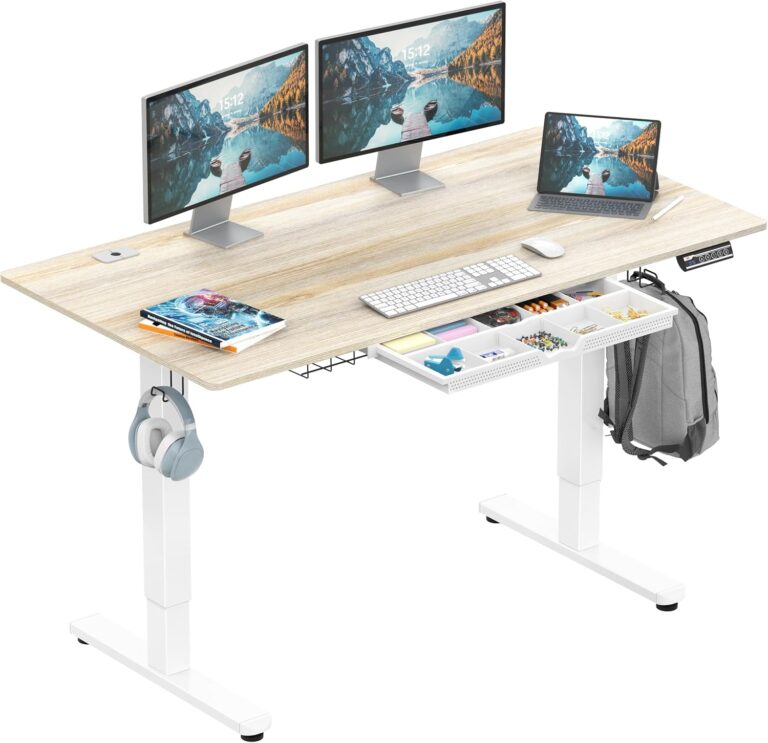
Objects shown to illustrate use are not a statement of included accessories; see the model and variant details.
SHW 55 × 28 standing desk
An electric height-adjustable desk with a 55 × 28 inch maple-finish top and a drawer. The wider top gives a different workspace from a compact desk converter placed on existing furniture.
Variant: Maple finish / 55 × 28 in / drawer
Measure the complete desk footprint and the usable space around the drawer. Check the supported equipment load and leave cable slack for the full height movement.
View product details →View on Amazon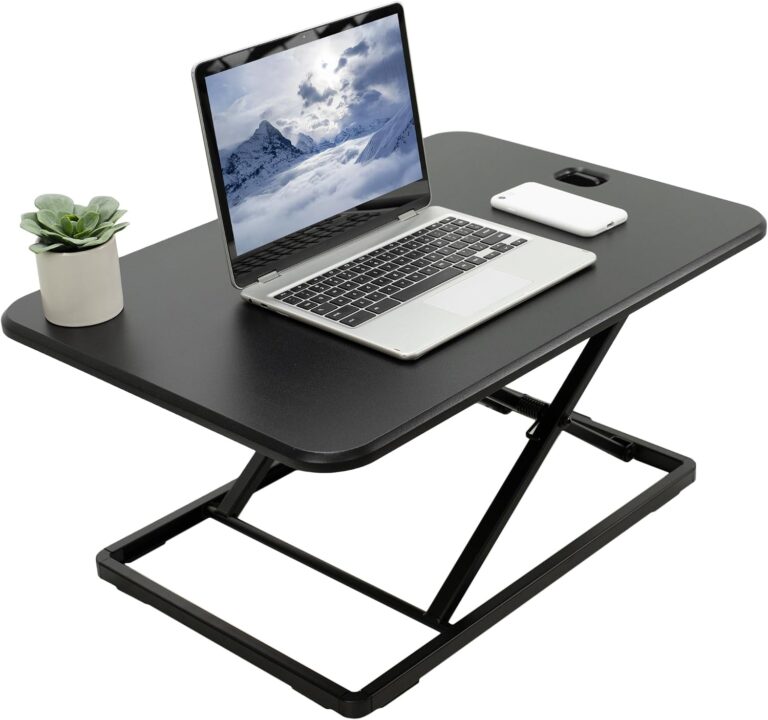
Objects shown to illustrate use are not a statement of included accessories; see the model and variant details.
VIVO 26-inch desk converter
A black 26-inch single-platform sit-stand converter identified as DESK-V001J. It sits on an existing desk rather than replacing the whole desk frame.
Variant: Black / 26-inch single top
Measure your existing desk and the equipment footprint together. A single top does not provide a separate keyboard tray; check the resulting screen and keyboard heights before choosing.
View product details →View on AmazonBuyer's guide: what to look for in a standing desk
A standing desk for a small room: verify the frame and desktop as a set
Measure the desktop space and the clearance needed when the desk moves. Compare the exact frame’s minimum and maximum height with your intended seated and standing setup. Check which desktop sizes it supports and whether the stated load limit applies to the configuration you are buying.
Compare the frame and desktop documentation together rather than relying on a family name alone — the same desk line often ships in several frame and desktop-size combinations with different height ranges and load limits.
Desk size and footprint
The first number to check is the top dimensions — width and depth. In a small space, a 48-inch wide desk allows for a monitor, laptop, and keyboard without extending too far along the wall. A 55-inch wide desk fits more surface area but may crowd a compact office. Depth (front-to-back) is equally important: most standard desks are 24–30 inches deep. Confirm the full standing frame dimensions, not just the tabletop, since the frame legs often extend to the sides of or beyond the top edge.
Height range
An electric standing desk should comfortably reach both your seated elbow height and a standing elbow height. At standing height, the desk surface should sit at or just below elbow level when standing with arms relaxed at your sides. Most adults fall within the 38–48 inch standing elbow range. For seated work, the target is typically 26–30 inches. Desks with a minimum height above 28 inches may sit too high for shorter users in a standard chair.
Motor type
Single-motor desks adjust more slowly and have lower weight capacities than dual-motor models. For a laptop and single monitor setup, a single motor is generally sufficient. For a dual-monitor setup, a full tower PC, or a setup with heavy accessories, a dual-motor frame provides more lifting power and stability during height adjustment.
Memory presets
Memory preset controllers allow you to store your preferred sitting and standing heights as numbered buttons. When you want to switch positions, pressing a button adjusts the desk automatically. Models without presets require holding up/down buttons and watching the digital height display. For frequent position switching, presets reduce friction and make it more likely the desk gets used for what it was bought for.
Desk converters vs. full standing desks
A desk converter is not a compromise — it is a different product format. Converters work well when you already have a desk surface you are satisfied with, when you cannot anchor hardware to a floor or wall (renters), or when a full standing desk is outside budget. The limitation is a smaller working platform when raised. If you use a large monitor and a separate keyboard plus mouse, check the platform dimensions to confirm everything fits at standing height.
Frequently asked questions
What is the minimum space needed for a standing desk?
Most standard standing desks are 48–60 inches wide and 24–30 inches deep. For a small space setup, measure the wall section where you plan to place the desk including clearance at sides and behind for cables. Desks in the 48×24 inch range work for many compact home office setups.
Are desk converters a good alternative to full standing desks?
Desk converters sit on top of an existing desk and raise a monitor or laptop to standing height. They are a practical option for renters, those with limited budgets, or anyone who wants to try a standing work position without replacing an existing desk. The trade-off is a smaller platform compared to a full-sized standing desk.
What is the difference between single-motor and dual-motor electric desks?
Dual-motor desks adjust faster and typically support higher weight capacities than single-motor models. Single-motor desks tend to cost less and work well for standard single-monitor setups. If the desk will hold two monitors, a desktop computer, and accessories, a dual-motor model offers more lifting power and stability during adjustment.
Do electric standing desks need assembly?
Yes. Most electric standing desks ship as a frame and top and require assembly that typically takes 30–60 minutes. Assembly usually involves attaching the legs, connecting the motor cable to the controller, and securing the tabletop. Instructions are included, and the process is generally manageable for one person.
Can a standing desk help with posture?
A standing desk allows you to vary your working position between sitting and standing throughout the day. Whether standing or sitting, maintaining a neutral wrist and screen-at-eye-level position is what matters most for desk setup comfort. We describe these products as useful for changing work positions — not as medical or posture correction devices.