Best Balcony Planters: Railing Box Pick and Buying Criteria for 2026
The best balcony planters in 2026 — a verified railing planter box, plus buying criteria for self-watering and hanging planter formats. No fake ratings, no live prices.
In this guide
Affiliate Disclosure:
As an Amazon Associate I earn from qualifying purchases. Product images shown may be representative lifestyle photos unless official product images are available through an approved Amazon data source. We do not display live prices, ratings, or availability.
Representative outdoor lifestyle image — view exact product photos on Amazon.
Who This Guide Is For
This guide is for apartment dwellers, renters, and homeowners looking to add plants to a balcony, small patio, or compact outdoor space using pots and planters suited to limited floor area, weight restrictions, and urban growing conditions. It features a railing planter box that mounts on the balcony railing to free up floor space, plus buying criteria for self-watering and hanging planter formats where we could not verify a specific model.
We are not covering raised garden beds, vertical wall-mounted planters, or large in-ground pots. This guide focuses on balcony-specific mounting formats — railing-mounted boxes, hanging planters, and window boxes — suited to compact spaces where floor area is limited. We are not covering soil mixes, plant selection, or fertilizer recommendations, which vary by plant type and climate.
Quick Picks
Best Railing Planter Box: OYEAL Railing Planter Box (mounts on balcony railings and fences, vertical growing without floor space)
How We Chose These Planters
We research, compare, and explain products based on use cases, specifications, public product information, and buyer needs. Our selection criteria for balcony planters:
Format diversity: We selected one railing planter box (for railing-mounted growing without using floor space), one self-watering window box (for reduced watering frequency), and one hanging planter (for hook or railing suspension) to cover the main balcony-specific planter formats.
Drainage: The verified railing planter has drainage holes — we exclude planters with no drainage mechanism from consideration, as standing water at the root zone causes root rot in most plants.
Weight consideration: The verified railing planter is resin or lightweight plastic, not ceramic or concrete — important on balconies where floor and railing weight limits can be a concern. Railing planters distribute weight along the railing rather than the floor; verify your railing’s load rating before mounting heavy planters or filling with dense soil.
Honest labeling: No frost-proof, indestructible, or all-season claims. We describe materials and what that means for longevity outdoors.
Things to Know Before You Buy a Balcony Planter
Balcony Planter Checklist
Check your balcony’s weight limit before adding multiple large containers. Apartment balconies typically have a live load capacity in the range of 40–60 lbs per square foot. A large planter filled with soil can weigh 50–100 lbs or more. If you plan to add several large containers, confirm the weight capacity with your building management before filling them with soil.
All planters need drainage — either holes or a reservoir system. A planter without drainage holes will drown most plants if you water them regularly. If you find a pot you like without drainage holes, use it as a cachepot around a grow pot with drainage inside, or place a layer of gravel at the bottom and water very sparingly (not ideal compared to proper drainage).
Lightweight resin planters are better than ceramic on balconies. Resin and polypropylene planters look similar to ceramic or concrete at far lower weight, making them safer for balcony floor load limits. They are also frost-resistant compared to terracotta, which can crack when frozen.
Use saucers to catch drainage water on balcony floors. Drainage water from pots contains soil particles and fertilizer that can stain concrete balcony floors and, on upper floors, drain through gaps to lower balconies. Using saucers under pots and emptying them regularly prevents staining and courtesy issues.
Self-watering planters work differently from regular pots. Self-watering planters have a separate water reservoir at the bottom. The plant draws water upward through a wick or fill tube as needed. You refill the reservoir — not the soil surface — when the indicator shows empty. This reduces watering frequency significantly but does not eliminate watering entirely.
Comparison Table
Product | Best for | Format | What to consider | Amazon |
|---|---|---|---|---|
OYEAL Railing Planter Box | Best Railing Planter Box | Railing-mount box, attaches to balcony railings and fences, no floor space required | Verify railing size compatibility and weight rating before mounting | View exact product |
Our Top Picks
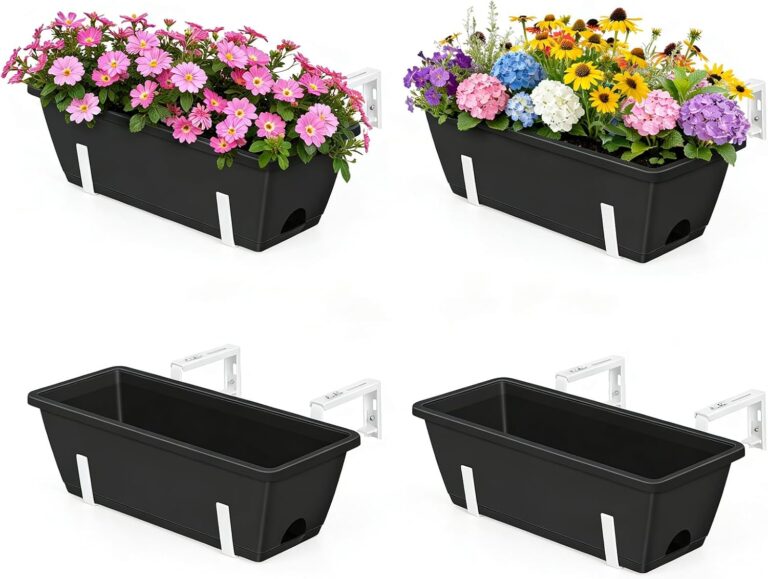
Four planter boxes; flowers are not included.
OYEAL railing planters, four-pack
Four railing planters with adjustable brackets for adding planting space along a balcony or fence. The set separates the planter boxes from their supports so the railing fit needs checking before installation.
Variant: Four black planters / white brackets
Check railing shape, permitted loads and drainage before filling the boxes. Flowers are illustrative. The listing has inconsistent width fields, so verify the full mounting dimensions rather than relying on the nominal 17-inch length alone.
View product details →View on AmazonBuyer's Guide: Choosing a Planter for a Balcony
Self-Watering vs. Conventional Planter: Which Is Right for a Balcony?
Self-watering planters are ideal for balcony use when daily watering is inconvenient — for example, apartment dwellers who travel, work long hours, or simply find daily watering too high-maintenance for warm summer months. The reservoir extends the time between waterings from daily to every few days to a week, depending on plant type and outdoor temperature. The tradeoff is that self-watering systems work best for moisture-tolerant plants like herbs, lettuce, tomatoes, and petunias. Plants that prefer to dry out between waterings (succulents, lavender, rosemary) are better suited to conventional planters with good drainage.
A self-watering window box: compare the container and the set contents
Measure the available ledge or support and the planting space you need. For a container advertised as self-watering, check how the reservoir is filled, how excess water drains and how the instructions describe its use — do not infer a watering interval from the product name alone.
Confirm whether the listing includes one rectangular planter or several containers of different shapes before buying — window-box listings sometimes bundle mixed planter sets, which may not fit a single window ledge the way a dedicated window box does.
Choosing a hanging planter for a balcony
Start with the mounting point, not the planter’s appearance. Measure the railing or hook and check the permitted load, including the container, wet growing medium and water. Choose a mounting system whose instructions cover that support; do not assume a generic hanging basket fits every railing.
Plan where excess water will drain and leave enough room to water and inspect the container regularly.
What Size Planter Do I Need?
Planter size should match the root space requirements of the plants you intend to grow. General guidelines:
Herbs (basil, parsley, chives): 6–10 inch diameter pot is sufficient for individual herbs; 8–12 inch for a mixed herb planter
Annuals and flowers (petunias, marigolds, impatiens): 10–14 inch diameter for individual plants, larger for mixed arrangements
Dwarf tomatoes and peppers: Minimum 12–16 inch diameter and at least 12 inches deep for adequate root volume
Dwarf shrubs and ornamental grasses: 16 inches or larger; fabric pots are also an option for larger shrubs
Weight Management on Balconies
Standard potting soil weighs approximately 40–50 lbs per cubic foot. A 16-inch diameter planter filled to a typical 14-inch depth contains roughly 1.5 cubic feet of soil — up to 75 lbs of soil alone, plus the weight of the pot and plant. For multiple large containers, the combined weight can become significant relative to balcony load limits.
To reduce weight: use lightweight potting mixes formulated for containers (which include perlite and other lightweight aggregates), use lightweight resin or plastic planters instead of ceramic or concrete, and consider smaller-diameter pots arranged in groups rather than a few very large containers.
Frequently Asked Questions
What type of planter works best for a small balcony?
For small balconies, lightweight planters are preferable to heavy ceramic or concrete pots because balconies have weight limits. Resin and plastic planters provide similar visual appearance to ceramic or stone at a fraction of the weight. Self-watering planter boxes positioned along the railing edge are an efficient use of limited balcony space.
Do balcony planters need drainage holes?
Yes — most plants require drainage holes at the bottom of the planter to prevent water from pooling at the root zone, which causes root rot. Planters without drainage holes can be used as cachepots (decorative outer pots) holding a smaller grow pot with drainage inside. Self-watering planters with a reservoir work differently — the reservoir is separate from the soil, but the soil compartment should still drain into the reservoir properly.
What is the advantage of a self-watering planter on a balcony?
Self-watering planters have a water reservoir at the bottom that feeds moisture to the soil from below as plants need it. This reduces watering frequency — instead of watering every day in summer, a self-watering planter may only need the reservoir refilled every few days to a week. On balconies where daily watering is inconvenient, self-watering planters can significantly reduce maintenance while keeping plants consistently moist.
How do I prevent my balcony planters from damaging the floor?
Place a saucer under each pot to catch drainage water and empty it regularly. For large planters, plant caddies (wheeled platform trays) allow you to move heavy pots without lifting and also catch drainage water. Avoid placing planters directly on wood decking without saucers, as constant moisture exposure will discolor and deteriorate the wood surface.
Can outdoor planters be left outside through winter?
Resin and plastic planters are generally more frost-tolerant than ceramic or terracotta pots, which can crack when water in the pores freezes. For best longevity, empty planters of soil at the end of the growing season if leaving them outdoors through winter, as frozen wet soil expands and can crack the planter. Bringing planters indoors or into a garage for winter extends their service life significantly.
Related Outdoor & Patio Guides
Best Patio Side Tables — Steel frame, Adirondack-style, and MgO concrete round side table options for small outdoor spaces
Best Outdoor Rugs for Patios — Polypropylene, reversible, and UV-resistant outdoor rug options for decks and patios
Best Outdoor Storage Boxes — Resin deck boxes for patio cushions, garden tools, and outdoor gear
Best Patio Umbrellas for Shade — 9ft market, cantilever offset, and compact umbrella options for outdoor shade coverage
Best Solar Pathway Lights — Solar-powered LED lights for garden walkways and patio edges
Outdoor & Patio Hub — All published Outdoor & Patio guides