Best Kitchen Knife Set with Block: What to Check Before Buying
Looking for the best kitchen knife set? Our guide compares knife block set types, what's typically included, and what to check before you buy.
In this guide
Affiliate Disclosure:
As an Amazon Associate I earn from qualifying purchases. Representative lifestyle images are shown. We do not display live prices, ratings, or availability.
Editorial illustration — view exact product photos on Amazon.
Quick Answer
Most home cooks stocking a kitchen from scratch do well with a forged knife block set, like the Cuisinart 15-Piece Knife Set with Block, which is designed to bundle a chef’s knife, slicing knife, santoku, utility knife, paring knives, steak knives, a sharpening steel, and a storage block into one purchase. A stamped (budget) knife block set can help keep common kitchen knives organized in one place at a lower price point, typically with thinner blades. A knife set without a block — sold as a roll or in-drawer tray — is designed for kitchens with limited counter space or cooks who prefer drawer storage. Check the included knife types, handle material, block size, and cleaning instructions before buying — and consider whether you actually need a full set or just a few individual knives for how you cook.
Who This Guide Is For
This guide is for home cooks who want to stock their kitchen with a coordinated set of knives rather than buying each one separately, whether that’s for a new kitchen, a kitchen upgrade, or replacing mismatched hand-me-down knives. If your current drawer is a mix of dull, mismatched blades with nowhere consistent to store them, a knife block set is designed to solve both problems at once.
This guide covers three types: forged knife block sets for a heavier, typically thicker-bladed set, stamped (budget) knife block sets for a lower-cost entry point, and knife sets without a block for kitchens with limited counter space. Check the comparison table and buyer’s guide below to decide which fits how you actually cook.
Quick Picks
Forged Knife Block Set: Good for home cooks stocking a kitchen from scratch who want a coordinated set with storage included
Stamped (Budget) Knife Block Set: Useful for a lower-cost entry point or a secondary set
Knife Set Without Block: Designed for kitchens with limited counter space or cooks who prefer drawer or roll storage
Comparison Table
Product | Model & variant | Choosing |
|---|---|---|
Cuisinart C77WTR-15P knife block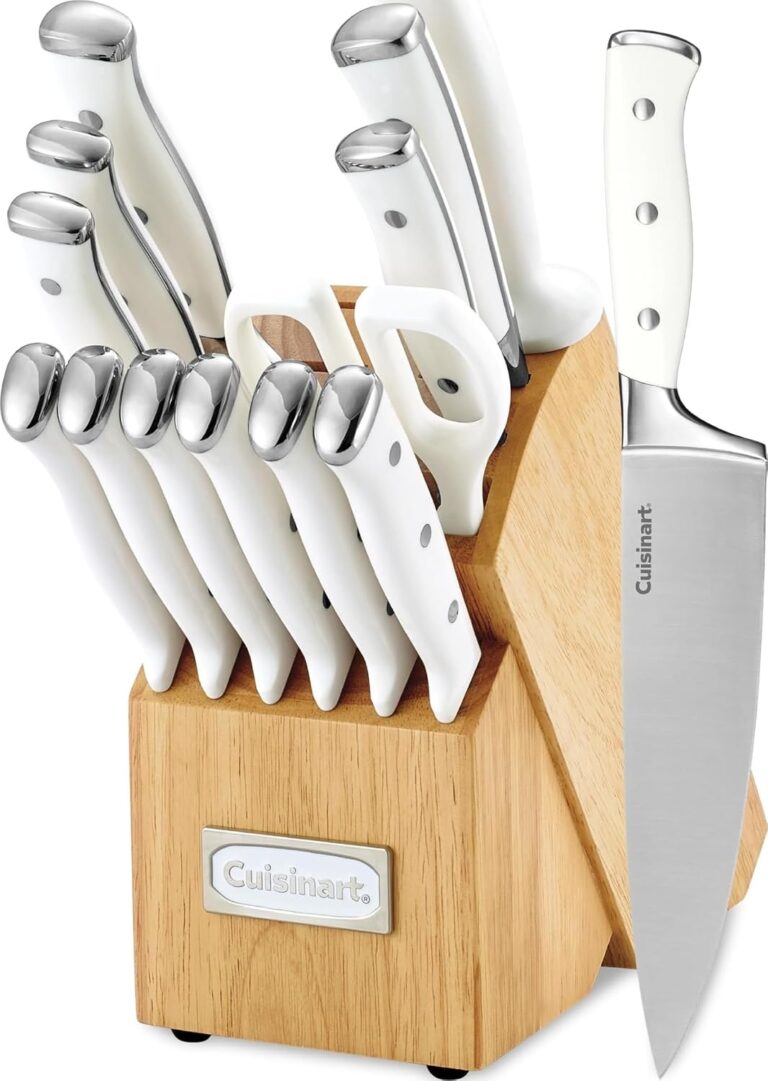 | C77WTR-15P White handles / 15-piece block set | Check whether the knife shapes match your everyday cutting tasks and whether the block fits below your cupboards. Plan safe cleaning and storage for the blades; the block occupies counter space. |
Note: The Cuisinart 15-Piece Knife Set with Block (ASIN B01ALYD1WI) has strong third-party evidence of its identity (Amazon listing, Cuisinart’s own official product page, and independent retailer cross-listings). Other entries use generic Amazon search links. Search results reflect availability at time of visit.
Knife Set vs. Buying Individual Knives
A knife block set bundles multiple knives — often a chef’s knife, slicing knife, utility knife, paring knives, and steak knives — along with a sharpening tool and storage block into one purchase. This can help keep common kitchen knives organized in one place, which is useful if you’re stocking a kitchen from scratch or want a coordinated look. Buying individual knives instead lets you choose exactly which blades you want, skip pieces you know you won’t use, and potentially put more of your budget toward the one or two knives you’ll use most (usually a chef’s knife). The trade-off is that you’ll need to source storage separately and compare each knife on its own rather than relying on a set’s bundled reputation. Many home cooks land somewhere in between: starting with a set, then replacing or adding individual knives over time as preferences develop.
Types of Kitchen Knife Sets
Cuisinart C77WTR-15P knife block
A 15-piece knife block set with white triple-rivet handles. The set combines kitchen knives with steak knives and other pieces, so compare the tools rather than relying on the total count.
Variant: White handles / 15-piece block set
Check whether the knife shapes match your everyday cutting tasks and whether the block fits below your cupboards. Plan safe cleaning and storage for the blades; the block occupies counter space.
View product details →View on AmazonKnife Sets
Stamped (Budget) Knife Block Set
Good for: A Lower-Cost Entry Point
Stamped knife block sets use blades cut from sheet steel rather than forged from a single billet, which typically means a lighter knife and a lower price point. May work well as a starter set, a secondary set for a second kitchen, or for cooks who want a full block without a higher budget. Check the manufacturer’s stated piece count and block dimensions before buying.
Format: Stamped steel blades, block included, typically lower piece count than forged sets
Consider if: You want a full knife block set at a lower price point and don’t need forged-blade weight
Knife Sets
Knife Set Without Block
Good for: Kitchens With Limited Counter Space
Knife sets without a countertop block are designed for kitchens where counter space is limited or where cooks prefer to store knives out of sight, typically packaged as a knife roll or an in-drawer tray. May work well for small apartments, RVs, or anyone who doesn’t want a block taking up counter space. Check the manufacturer’s stated blade guard or sheath design before buying, since safe drawer storage depends on it.
Format: Knife roll or in-drawer tray, no countertop block
Consider if: You have limited counter space or prefer knives stored out of sight
Buyer's Guide: What to Check Before Buying
Included Knife Types
Check the manufacturer’s exact contents list — sets vary widely in which knife types they include and how many pieces come with steak knives or specialty blades. Match the included knives against what you’d actually use rather than assuming a higher piece count means better value.
Handle Material
Check whether handles are plastic, wood, or a composite material, and whether they’re described as textured or contoured for grip. Handle comfort is a preference — consider trying a similar handle shape in person if possible before buying.
Block Size and Footprint
Measure your available counter space before buying, since knife blocks vary significantly in width, depth, and height. A block that looks compact in a photo can still take up more counter space than expected once it’s in your kitchen.
Cleaning Instructions
Check the manufacturer’s specific cleaning instructions for your exact set before assuming a cleaning method — do not assume any knife set is dishwasher-safe, rust-proof, or stain-proof unless the manufacturer explicitly and verifiably states it. Hand-washing is a common recommendation for kitchen cutlery generally.
Sharpening and Maintenance
Check whether the set includes a sharpening steel (for realigning an edge between sharpenings) versus an actual sharpener (for restoring a dull edge). These are different tools, and confusing them is a common buying mistake — see Common Mistakes below.
Storage & Block Considerations
A knife block is designed to store blades vertically or at an angle in individual slots, keeping edges protected from contact with other utensils and keeping knives within reach while cooking. Check the block’s material (wood or acrylic are common) and whether it has universal slots that fit knives of different sizes, versus fixed slots sized for the specific set. If counter space is limited, consider an in-drawer knife tray or a magnetic strip mounted on a wall as alternatives to a countertop block — both are designed to keep blades separated and protected without taking up counter footprint. Whatever storage method you choose, avoid storing loose knives in a drawer without any protection, since that can dull edges and creates a safety risk when reaching in.
Cleaning & Care
Care instructions vary by manufacturer and material, so check the specific guidance for your exact set rather than assuming a general rule applies. Hand-washing and drying knives promptly after use is a common care recommendation for kitchen cutlery generally, since prolonged moisture exposure and dishwasher heat/detergent cycles can affect blade and handle materials over time. Do not assume a knife set is dishwasher-safe, rust-proof, or stain-proof unless the manufacturer explicitly and verifiably states it for that specific product. Store knives in a block, tray, or on a magnetic strip rather than loose in a drawer, and use a sharpening steel periodically (if included) to help maintain the edge between full sharpenings.
Common Mistakes When Choosing a Kitchen Knife Set
Assuming a higher piece count means better value. Some sets pad the count with rarely-used specialty blades — check the actual contents list against what you’d use.
Confusing a sharpening steel with a sharpener. A steel realigns an edge between sharpenings; it does not restore a dull blade the way an actual sharpener does.
Not measuring counter space before buying. Knife blocks vary in footprint — measure before you buy, not after it arrives.
Assuming dishwasher-safe without checking. Follow the manufacturer’s specific cleaning instructions rather than assuming any knife set can go in the dishwasher.
Storing knives loose in a drawer. This can dull edges over time and creates a safety risk when reaching into the drawer — use a block, tray, or magnetic strip instead.
FAQ
What comes in a kitchen knife block set?
It varies by set, but a typical kitchen knife block set includes a chef’s knife, a slicing knife, a santoku or utility knife, a paring knife, a set of steak knives, a sharpening steel, and a wooden or acrylic block to store everything. Always check the manufacturer’s exact contents list for the specific set you’re considering.
What's the difference between a knife block set and buying individual knives?
A knife block set bundles multiple knives, often a sharpening tool, and storage into one purchase, which can be useful for stocking a kitchen from scratch. Buying individual knives lets you choose exactly which blades you want but usually means sourcing storage separately.
What should I check before buying a kitchen knife set?
Check the included knife types and piece count, the handle material, the block size and footprint, and the manufacturer’s stated cleaning instructions. Confirm whether the set includes a sharpening steel.
How should I clean and care for kitchen knives?
Follow the manufacturer’s specific care instructions for your exact set. Hand-washing and drying knives promptly after use is a common care recommendation — do not assume any knife set is dishwasher-safe unless the manufacturer explicitly states it. Store knives in a block, on a magnetic strip, or in blade guards rather than loose in a drawer.
Do I need a full knife block set, or just a few knives?
It depends on how you cook and what you already own. A full block set can help keep common kitchen knives organized in one place if you’re stocking a kitchen from scratch. If you already own a chef’s knife you like and only need one or two additional blades, buying individually may be more useful than a full set.