Best Kitchen Drawer Organizers: Utensil Trays, Cutlery Dividers, and Expandable Inserts for 2026
The best kitchen drawer organizers in 2026 — utensil trays, expandable cutlery dividers, and bamboo drawer inserts compared by size, material, and how they fit standard kitchen drawers. No fake ratings, no live prices.
In this guide
Affiliate Disclosure:
As an Amazon Associate I earn from qualifying purchases. Product images shown are representative lifestyle photos. We do not display live prices, ratings, or availability.
Representative kitchen lifestyle image — view exact product photos on Amazon.
Who This Guide Is For
This guide is for anyone who opens a kitchen drawer and has to dig through a jumble of spatulas, measuring spoons, and serving utensils to find the one thing they need. It covers three kitchen drawer organizer formats that serve different drawer sizes and storage needs: an expandable cutlery tray for the silverware drawer, a large utensil tray for cooking tools, and a bamboo modular insert system for kitchens that want a consistent material look across multiple drawers.
This guide does not cover built-in custom cabinetry drawer inserts, pull-out cabinet organizers installed by a carpenter, or knife drawer blocks integrated into a drawer system. It focuses on organizers that sit directly in standard kitchen drawers without requiring installation or modification to the drawer itself.
Quick Picks
Expandable Cutlery Tray: Adjustable-width divider with dedicated slots for forks, knives, spoons, and teaspoons — expands to fit drawer widths from approximately 13 to 21 inches
Large Utensil Tray: Multi-compartment tray with open sections sized for spatulas, ladles, whisks, and similar long cooking tools
Bamboo Modular Drawer Insert: Natural bamboo organizer with adjustable dividers — fits standard drawer dimensions and pairs well with bamboo kitchen accessories
Grow Forward Bamboo Drawer Organizer Boxes (B0CTYTDYFV): Good for kitchens that want individual bamboo boxes arranged freely to match a specific drawer layout — each box is a separate unit that can be repositioned without replacing the whole organizer
How We Chose These Formats
We focused on drawer organizer formats that address the three most common kitchen drawer scenarios:
Adjustability: Kitchen drawers vary in width. We prioritized formats that either expand to fit a range of drawer sizes or are modular enough to be combined for different configurations.
Content type match: Cutlery and cooking utensils have different storage needs. A 5-slot cutlery divider is appropriate for a silverware drawer; a more open tray with fewer, larger compartments works better for spatulas and ladles.
No-installation required: All formats sit freely inside the drawer without adhesive, screws, or drawer modification — so they work in rental apartments and can be moved or replaced without effort.
Things to Know Before You Buy a Kitchen Drawer Organizer
Drawer Organizer Checklist
Measure the interior of your drawer, not the outside. Drawer organizers must fit inside the drawer with enough clearance for the drawer to close. Measure interior width, depth, and height from the bottom of the drawer to where the drawer frame begins.
Decide which utensils go in which drawer before ordering. If you plan to consolidate all kitchen tools into one drawer, measure that drawer and look for a system with both small cutlery sections and large open sections. If tools will go in a separate drawer from cutlery, you can use specialized organizers for each.
Check whether a bamboo organizer fits your drawer depth. Bamboo organizers are often designed for standard 21-inch deep drawers. If your drawers are shallower or deeper, look for listings that specify exact dimensions.
Consider whether you want the organizer to fill the whole drawer. Expandable organizers can be stretched to fill the drawer wall-to-wall, which keeps them from sliding. Fixed-size trays that are smaller than the drawer will move when the drawer is opened and closed — this can be managed with non-slip drawer liner material placed underneath.
Account for tall items in your utensil collection. Long cooking tools like pasta tongs or large spatulas may extend above a low-profile drawer organizer’s sides. Look for trays with sides tall enough to keep tools upright, or choose a more open-top design that simply groups items by area without fully containing them.
Comparison Table
Product | Model & variant | Choosing |
|---|---|---|
Grow Forward bamboo drawer boxes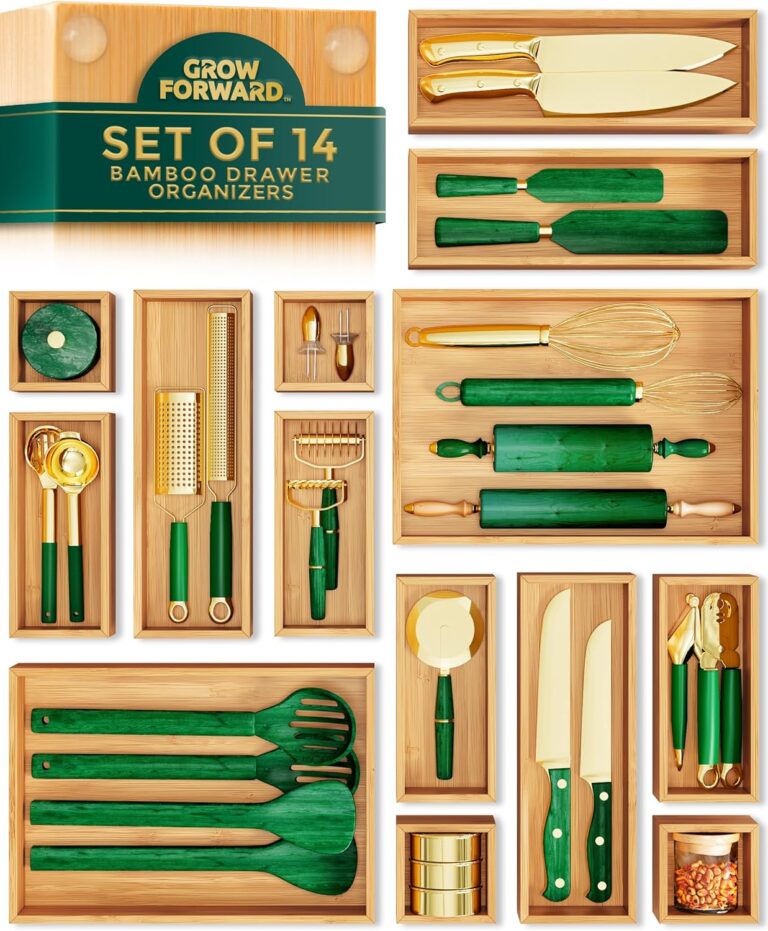 Objects shown to illustrate use are not a statement of included accessories; see the model and variant details. | 14-Piece Bamboo Drawer Organizer Natural bamboo / 14 boxes | Measure the inside of the drawer, including its usable height. Plan the combination of box sizes; the full set does not necessarily fit in one drawer. |
Note: Grow Forward Bamboo Organizer Boxes (B0CTYTDYFV) is a verified ASIN. Other rows use generic Amazon search links for discovery. Search results reflect current availability at time of visit.
Drawer Organizer Formats
Representative kitchen lifestyle image — view exact product photos on Amazon.
Drawer Organizers
Expandable Cutlery Tray
Best for: Silverware Drawers With Non-Standard Widths
An expandable cutlery tray has a spring-loaded or sliding mechanism that allows the tray to widen to fill drawer widths across a range — typically from about 13 to 21 inches wide. The interior is divided into dedicated slots for forks, dinner knives, tablespoons, teaspoons, and an extra section for other small utensils. The expansion mechanism also holds the tray in place against the drawer walls, preventing it from sliding. Made in plastic and typically dishwasher-safe for the individual sections. Useful for households where cutlery storage currently means loose silverware rattling around in an unorganized drawer.
Format: Spring-expanding frame with fixed slot sections for cutlery types
What to consider: The expansion mechanism adds some height — verify it clears the drawer frame when closing
Representative kitchen lifestyle image — view exact product photos on Amazon.
Drawer Organizers
Large Utensil Tray
Best for: Cooking Tools That Are Too Large for a Standard Cutlery Divider
A large utensil tray has 3 to 5 open sections with interior dimensions sized for cooking tools that are wider and longer than standard cutlery — spatulas, ladles, tongs, whisks, can openers, and peelers. Unlike a cutlery tray with narrow individual slots, a utensil tray uses fewer, larger compartments that can hold a variety of tool shapes without forcing them into a mismatch. Typically made in plastic or coated steel. Available in different sizes — match the tray dimensions to your cooking tools drawer, and look for listings that specify interior compartment sizes rather than just overall dimensions.
Format: Rectangular tray with 3–5 open compartments; no adjustment mechanism
What to consider: Fixed size — add non-slip drawer liner underneath if the tray is smaller than the drawer
Representative kitchen lifestyle image — view exact product photos on Amazon.
Drawer Organizers
Bamboo Modular Drawer Insert
Best for: Kitchens That Prefer a Natural Material Aesthetic
A bamboo modular drawer insert has a fixed outer frame in bamboo with adjustable interior dividers that slide into different positions, letting you customize the number and size of compartments. This makes it useful for drawers that hold a mix of items — some sections can be wide for cooking tools, others narrow for small accessories like twist ties, rubber bands, or small kitchen gadgets. Bamboo resists odors better than plastic over extended use and is generally more durable. Not dishwasher-safe — clean with a damp cloth. Available in standard drawer depths (typically 21 or 24 inches) so measure before ordering.
Format: Bamboo frame with movable dividers; customizable compartment layout
What to consider: Not dishwasher-safe; fixed outer dimensions must match your drawer — check exact width and depth
Objects shown to illustrate use are not a statement of included accessories; see the model and variant details.
Grow Forward bamboo drawer boxes
A set of 14 natural-color bamboo organizer boxes. Separate boxes let you arrange a drawer around different item sizes rather than use one fixed cutlery tray.
Variant: Natural bamboo / 14 boxes
Measure the inside of the drawer, including its usable height. Plan the combination of box sizes; the full set does not necessarily fit in one drawer.
View product details →View on AmazonBuyer's Guide: Choosing a Kitchen Drawer Organizer
Material Considerations
Plastic organizers are the most practical for a cutlery drawer because they can be run through the dishwasher periodically. Bamboo is better for a utensil drawer where the organizer is less likely to be removed for washing. Coated steel offers a clean look and is resistant to moisture, but typically comes in fewer size configurations than plastic.
Drawer Depth vs. Organizer Depth
Most drawer organizer listings specify width and length — but drawer depth (the measurement from the bottom of the drawer to the top of the drawer frame) matters too. A very deep drawer can hold a tall organizer, which helps keep tall utensils upright. A shallow drawer may limit you to flat, low-profile trays. Verify both dimensions before ordering.
Modular vs. Single-Piece
A single-piece organizer is simpler and more stable if it matches your drawer well. A modular system — multiple separate trays that fit together — gives more flexibility for different drawer configurations or for reorganizing over time. Some households use a modular approach: one narrow tray for cutlery, one wide tray for tools, and a small accessory tray for miscellaneous items, all in the same drawer.
Related Kitchen Organization
If you are also organizing cabinets, see Best Kitchen Cabinet Organizers. For pantry and dry goods storage, see Best Pantry Organizers and Best Food Storage Containers. For spice storage specifically, see Best Spice Racks.
Common Mistakes When Buying Drawer Organizers
Ordering without measuring first. This is the most frequent cause of returns. Always measure interior drawer width and depth before placing an order.
Expecting one organizer to hold all kitchen tools. Spatulas and forks do not belong in the same compartment. Two drawer organizers in two drawers — one for cutlery, one for cooking tools — is almost always more functional than one large shared tray.
Choosing a bamboo organizer that is not dishwasher-safe for a food-contact drawer. If you plan to clean the organizer by machine, choose plastic. Bamboo can warp and crack with repeated dishwasher cycles.
Getting an organizer that is narrower than the drawer. A loose-fitting organizer will slide every time the drawer is opened. Either use an expandable model that fills the full width, or place non-slip drawer liner underneath a fixed tray.
Frequently Asked Questions
What size drawer organizer fits a standard kitchen drawer?
Standard kitchen drawers in the U.S. are typically 12, 15, or 18 inches wide and 20 to 24 inches deep. Before purchasing, measure the interior width and depth of your drawer — do not estimate from the outside. Expandable organizers can be stretched to fit within a range (such as 13 to 21 inches wide), making them a good choice when your drawer width falls between fixed sizes.
What is the difference between a utensil tray and a cutlery divider?
A utensil tray has a few large open compartments for cooking tools like spatulas, ladles, and tongs. A cutlery divider has narrow dedicated slots for forks, knives, spoons, and teaspoons. Many kitchens use one of each in separate drawers.
Are bamboo drawer organizers better than plastic ones?
Bamboo is more durable and resists odors better over time. Plastic is lighter, less expensive, and often dishwasher-safe. The best choice depends on your kitchen’s aesthetic preferences and whether you want machine-washing capability.
Can I use drawer organizers in drawers that are not perfectly square?
Yes. Expandable drawer organizers use a tension mechanism to fit irregular widths. Modular trays can be arranged to fill odd-shaped drawers. Measure carefully and look for organizers with adjustment ranges that match your drawer’s actual interior dimensions.
How many compartments do I need in a kitchen drawer organizer?
For cutlery: a 5-slot organizer (forks, knives, tablespoons, teaspoons, extras) is the standard. For cooking utensils: 3 to 4 large compartments are typically enough. For a mixed-use drawer, a modular system with both small and large sections gives the most flexibility.