Best Automatic Pet Feeders: Wi-Fi and Programmable Picks for 2026
The best automatic pet feeders in 2026 — Wi-Fi smart and simple programmable picks for cats and dogs. Honest guide: no fake ratings, no live prices, no veterinary claims.
In this guide
Affiliate Disclosure:
As an Amazon Associate I earn from qualifying purchases. Product images shown may be representative lifestyle photos unless official product images are available through an approved Amazon data source. We do not display live prices, ratings, or availability.
Representative pet lifestyle image — view exact product photos on Amazon.
Who This Guide Is For
This guide is for cat and dog owners who want to automate dry food feeding routines. It covers two feeder types at distinct points: a Wi-Fi app-controlled smart feeder for households that want remote schedule management and a straightforward digital timer feeder for a simple no-app setup.
We are not covering wet food feeders, raw food dispensers, or feeders marketed primarily with health or medical claims. We focus on practical dry food scheduling for everyday pet care.
Quick Picks
Best Wi-Fi Smart Feeder: PETLIBRO Granary WiFi Feeder (5L, 5G app control)
Best Simple Programmable Feeder: PetSafe Simply Feed (24-cup, digital timer)
How We Chose These Feeders
We research, compare, and explain products based on use cases, specifications, public product information, and buyer needs. Our selection criteria for automatic pet feeders:
Capacity: We selected feeders across the 5L–7L range to cover different refill preferences and pet sizes.
Connectivity: One pick offers Wi-Fi app control; the other two operate via onboard controls without requiring a network.
Power reliability: We prioritized feeders with dual power options where available to reduce disruption during outages.
Ease of setup: We avoided feeders with complex multi-step setup processes not suited for everyday household use.
Honest labeling: No medical claims. No “improves health” language. We describe what the feeder does — schedule and dispense dry food.
Things to Know Before You Buy an Automatic Pet Feeder
Automatic Pet Feeder Checklist
Wi-Fi feeders require a stable home network. App-controlled feeders like the PETLIBRO connect to your 2.4GHz or 5G home Wi-Fi. If your router placement results in a weak signal in the area where you place the feeder, consider a non-Wi-Fi model or a Wi-Fi extender.
Capacity is about refill frequency, not just pet size. A 5L feeder holds approximately 1–2 weeks of food for a single average-size cat. A 7L feeder reduces that to a longer interval. Match capacity to how often you want to refill, not just the number of pets.
These feeders are for dry or semi-moist food only. Neither pick here dispenses wet or refrigerated food. If your pet eats wet food, you need a different category of feeder with a cooling or refrigeration component.
Stainless steel bowls are easier to clean than plastic. Both the PETLIBRO and PetSafe include stainless steel bowls. Plastic bowls can absorb odors and bacteria over time; stainless steel is generally easier to clean and maintain.
Programming is permanent until changed. Scheduled feeding programs stay active until you change them. If your schedule shifts — holidays, travel, remote work changes — update the feeder accordingly rather than assuming the old schedule still applies.
Comparison Table
Product | Best for | Format | What to consider | Amazon |
|---|---|---|---|---|
PETLIBRO Granary WiFi Feeder | Best Wi-Fi Smart Feeder | 5L, 5G/2.4G WiFi, up to 10 meals/day | Requires compatible Wi-Fi network for app features | View exact product |
PetSafe Simply Feed Feeder | Best Simple Programmable Feeder | 24-cup (≈5.5L), digital timer, adjustable portions | No Wi-Fi app control on base model | View exact product |
Our Top Picks
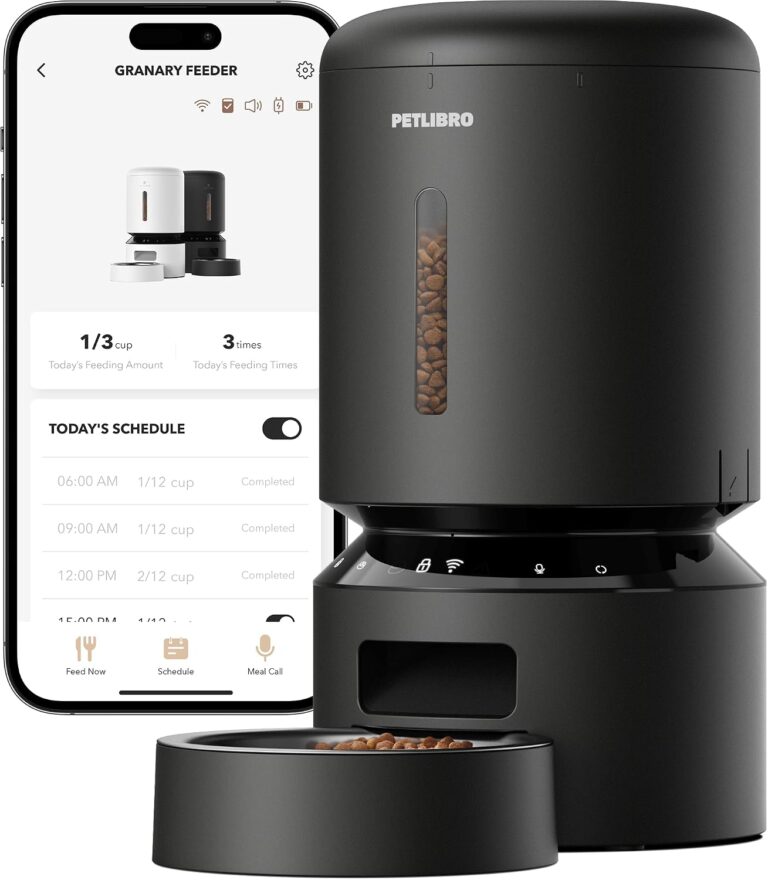
Objects shown to illustrate use are not a statement of included accessories; see the model and variant details.
PETLIBRO Granary WiFi 5 L feeder
A black Granary automatic feeder with a 5 L reservoir and Wi-Fi app control. The PLAF103 adds remote scheduling to a food dispenser rather than simply storing a bag of kibble.
Variant: Black / Granary WiFi / 5 L
Check the supported food dimensions, network requirements and power arrangements. A full hopper and an app schedule do not confirm that the pet has eaten; inspect dispensing and cleanliness regularly.
View product details →View on Amazon
PetSafe Healthy Pet Simply Feed
A programmable pet feeder with a 24-cup food reservoir and a stainless-steel bowl. This Simply Feed model schedules dispensing rather than relying on a continuously open gravity hopper.
Variant: 24-cup reservoir / stainless bowl
Check the accepted food shape and size and calibrate portions for your pet. Reservoir capacity is not a feeding recommendation, and scheduled dispensing does not replace checking the animal and feeder.
View product details →View on AmazonBuyer's Guide: Choosing the Right Automatic Pet Feeder
Choosing a programmable feeder: capacity is only one check
Compare the documented feeding schedule and portion settings with the routine you need. Check the permitted food size, cleaning access and the instructions for a power loss. Reservoir capacity alone does not establish portion accuracy or how long a feeder can be left without attention.
Check the exact capacity, meal-count range and power options printed on the specific model’s own listing before relying on them — feeders in the same family are often sold in more than one capacity and battery configuration.
Wi-Fi vs. Programmable: Which Do You Need?
Wi-Fi feeders add convenience for households where feeding schedules change frequently or where remote monitoring is useful. If you travel for work, a Wi-Fi feeder lets you confirm that meals dispensed correctly. Programmable feeders are simpler — set the schedule once and it runs consistently without any app dependency. For most stable households with consistent routines, a programmable feeder is sufficient.
Capacity and Refill Frequency
An average indoor cat eats roughly 1/4 to 1/2 cup of dry food per day. A 5L feeder holds approximately 20 cups, or 40–80 days of food for one cat. A 7L feeder extends that further. For multiple cats or a medium dog eating more per day, capacity fills faster. Match your capacity choice to a refill interval that works for your routine — weekly, biweekly, or monthly.
Portion Control Considerations
Automatic feeders dispense in pre-measured portions based on the scheduled meal count and portion size. If your pet’s feeding amounts are prescribed by a veterinarian, verify that the feeder can dispense the exact portion size required. Most feeders in this category dispense in increments — verify the increment size in the product specifications before ordering.
Placement and Power Access
Place the feeder in a consistent, accessible location near a power outlet. Avoid placing it near water sources or in humid areas. For Wi-Fi feeders, confirm the placement has adequate signal strength from your router before finalizing the location.
Frequently Asked Questions
What is the difference between a Wi-Fi feeder and a programmable feeder?
A programmable feeder uses an onboard timer and LCD controls to set feeding schedules without any internet connection. A Wi-Fi feeder connects to your home network and allows you to adjust schedules, portion sizes, and get alerts via a smartphone app from anywhere. Wi-Fi feeders offer more flexibility for households where feeding times change frequently. Programmable feeders are simpler to set up and operate, with no dependency on a network or app.
How much dry food capacity do I need in an automatic feeder?
For one cat or small dog, a 3–5 liter capacity feeder typically holds 1–2 weeks of dry food between refills, depending on daily portion sizes. For multiple pets or larger dogs, a 6–7 liter capacity reduces refill frequency. Match capacity to how often you want to refill, not just the number of pets.
Can automatic feeders handle wet food?
The two feeders in this guide are designed for dry or semi-moist food only. Wet or canned food requires a different type of feeder with a refrigeration or cooling system to keep meals fresh. If you need wet food scheduling, look for feeders specifically listed as wet food compatible — these are a different product category.
What happens if the power goes out with an automatic feeder?
Power outage behavior varies by model. Some feeders include a dual power supply with both an AC adapter and battery backup, so they continue operating if power is interrupted. The PETLIBRO WiFi feeder and PetSafe Simply Feed rely on AC power; check whether they include battery backup or memory retention for programming after a power interruption.
Are automatic feeders easy to clean?
Most automatic feeders in this category have removable food trays and bowls that are dishwasher safe or hand-washable. The food hopper itself is not typically submersible. Most manufacturers recommend cleaning the bowl weekly and the hopper each time you refill it. Stainless steel bowls are easier to clean than plastic and less prone to retaining odors.
Related Pet Essentials Guides
Best Pet Hair Cleanup Tools — Reusable lint rollers, carpet rakes, and handheld vacuums for managing pet hair on furniture and rugs.
Best Pet Travel Accessories — Carriers, travel water bottles, and car seat covers for trips with cats or dogs.
Pet Essentials Hub — All published Pet Essentials guides in one place.